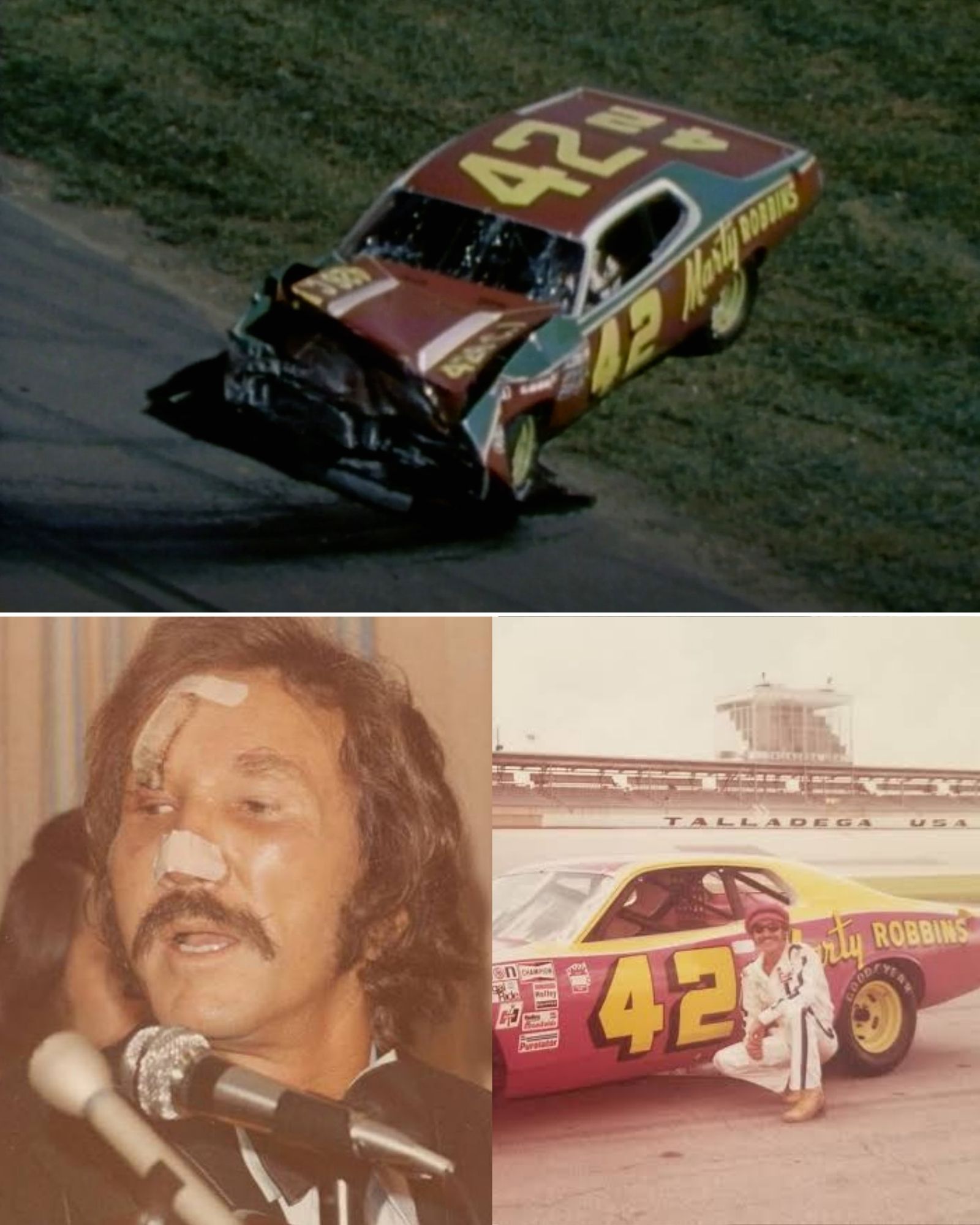
Marty Robbins was a Grand Ole Opry star, a Country Music Hall of Famer, and one of the most beloved voices of his generation. But on October 6, 1974, at Charlotte Motor Speedway, he made a decision that had nothing to do with music. With a stalled car sitting broadside in front of him, he steered his own race car into a concrete wall at around 160 miles an hour.
The man in that stalled car was Richard Childress. He has said he would not be alive without what Marty did that day.
A Country Star Who Really Raced
Marty Robbins did not treat racing as a publicity stunt. He grew up near the Fairgrounds Speedway in Nashville and started racing there on weekends after his Opry shows. By 1966 he had reached NASCAR’s top series, and he kept racing part-time for years in his famous purple and yellow No. 42 Dodge. His best finish came in 1974, a fifth place at Michigan.
Other drivers knew he was serious. Richard Childress once joked to reporters that Marty took care of his car himself, and that he had just seen him walking around with a can of wax, getting ready to shine it up.
A Wreck Across the Front Straightaway
The 1974 National 500 had barely started when trouble broke out. Early in the race, a wreck on the front straightaway left Richard Childress and several other drivers piled up across the track.
Childress’s car came to rest sideways, with the driver’s side door facing the oncoming field. A car hitting him there at full speed would have struck exactly where he was sitting.
Marty Robbins came onto the straightaway at around 160 miles an hour and found the track blocked. Childress later described the moment he looked up:
“I looked down the track and saw Marty coming right at me.”
The Split-Second Choice
Marty had almost no time to think. He could hold his line and plow into the stalled cars, or he could take the hit himself. He turned the wheel to the right, and his Dodge slammed into the concrete wall.
According to accounts of the race, the crowd went quiet until Marty was finally seen climbing out of the mangled No. 42.
He was taken to Charlotte Memorial Hospital. Reports differ slightly on the number, but doctors needed more than 30 stitches to close the gash on his face. He also suffered broken ribs, a broken tailbone and two black eyes.
“He Could Have Killed Himself”
After the race, a NASCAR official said that what Marty did had saved at least one life and probably kept other drivers from serious injury. He added that Marty could have killed himself turning into the wall that way.
Richard Childress put it even more simply:
“I wouldn’t be here talking to you right now.”
He said that was the truth, because Marty Robbins had risked his life to save him. Both men talked about the crash again in the March 1975 issue of Country Song Roundup.
The Life He Saved
Richard Childress did not just survive. A few years later he stepped out of the driver’s seat and focused on building his own team, Richard Childress Racing. It became one of the most successful organizations in NASCAR history, and it was where Dale Earnhardt won six of his seven championships. Today, Childress is a NASCAR Hall of Famer and still runs the team.
Marty Robbins kept racing after his injuries healed. His final NASCAR race came at Atlanta in November 1982, just weeks before he died that December. The next year, the annual race at Nashville was renamed the Marty Robbins 420 in his honor.
Many people remember Marty Robbins for his songs. The people who were at Charlotte that October day remember him for the moment he turned the wheel.