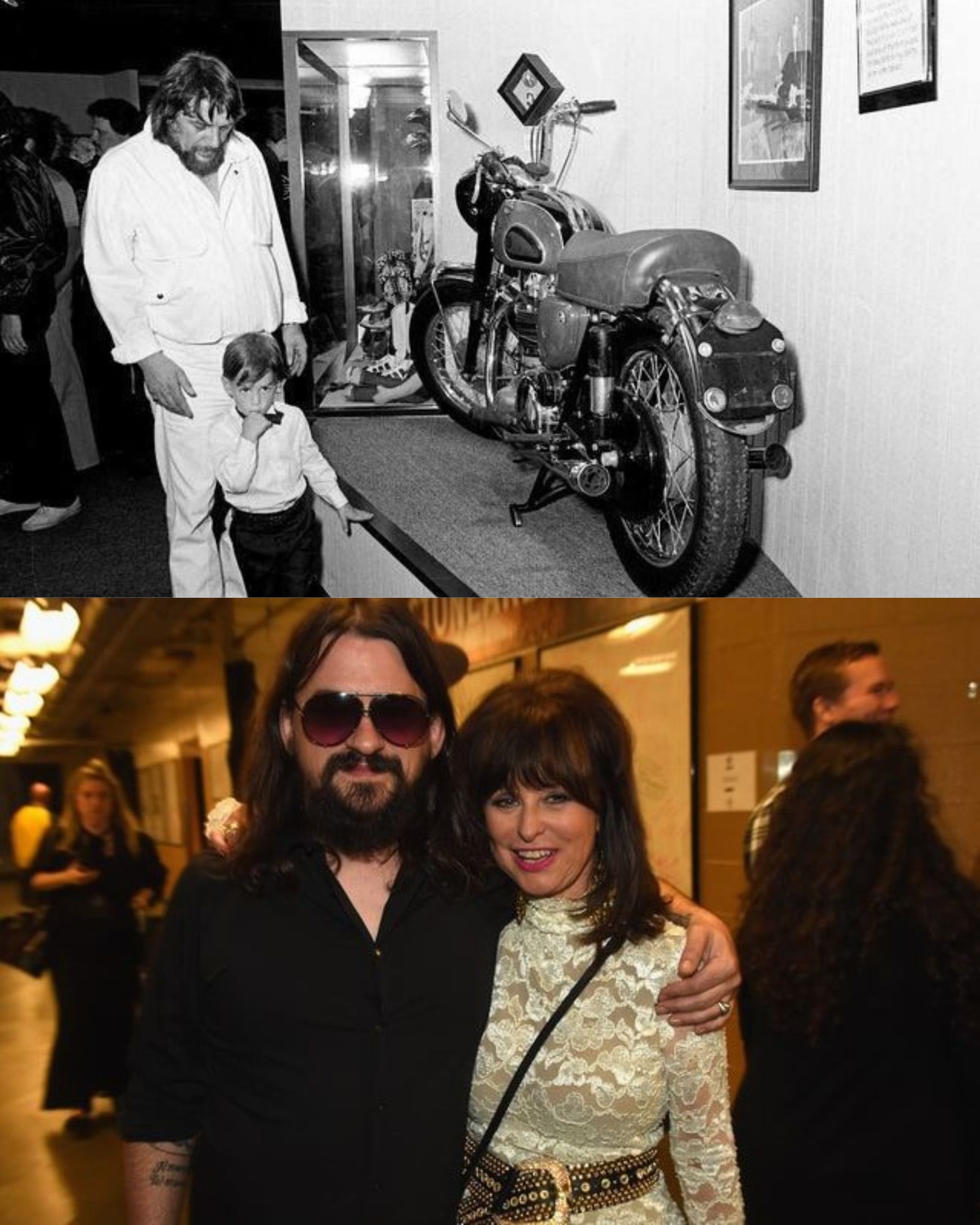
On June 15, 2008, Shooter Jennings walked onto a stage in Birmingham, Alabama, carrying something more personal than an ordinary setlist.
It was Father’s Day in America. It was also what would have been Waylon Jennings’ 71st birthday.
For Shooter Jennings, the occasion had another meaning. It was the first Father’s Day since becoming a father.
Waylon Jennings had been gone for more than six years, but that evening, Shooter Jennings found a way to bring the memory of Waylon Jennings back to the stage.
Partway through the concert, Shooter Jennings asked the entire band to leave. Then Shooter Jennings sat alone at an electric Fender Rhodes piano and introduced a song Waylon Jennings had often called a personal favorite.
It wasn’t one of the enormous country hits most fans would have expected.
The song was called “Belle of the Ball.”
A Father’s Day That Became a Family Memory
The story of that evening was later shared by music producer Witt Stewart, who had traveled to Birmingham with Waylon Jennings’ widow, Jessi Colter.
The night before, Witt Stewart and Jessi Colter had been discussing plans for a tribute recording honoring Waylon Jennings. Jessi Colter explained that a project of such importance would need the involvement and approval of Shooter Jennings.
When Witt Stewart learned that Shooter Jennings was scheduled to perform at a music festival in Birmingham the following evening, Witt Stewart suggested making the trip.
Neither Witt Stewart nor Jessi Colter could have anticipated just how meaningful that concert would become.
Standing offstage, Witt Stewart and Jessi Colter watched Shooter Jennings perform with the band. More than halfway through the show, Shooter Jennings stopped the usual concert routine.
After the musicians left, Shooter Jennings reminded the crowd that the day was Father’s Day and explained that it was the first Father’s Day since becoming a father.
The audience responded enthusiastically.
Then Shooter Jennings mentioned that June 15 was also Waylon Jennings’ birthday.
According to Witt Stewart, the crowd’s response grew even louder.
What followed was a deeply personal performance of “Belle of the Ball,” with Shooter Jennings alone at the keyboard.
Witt Stewart later admitted that the performance brought Witt Stewart close to tears.
Why “Belle of the Ball” Meant So Much to Waylon Jennings
Waylon Jennings originally released “Belle of the Ball” in 1977 on the album Ol’ Waylon. The recording also appeared as the B-side of the hugely successful single “Luckenbach, Texas (Back to the Basics of Love).”
Unlike that familiar country anthem, “Belle of the Ball” never became one of Waylon Jennings’ biggest radio hits.
But commercial success wasn’t the reason Waylon Jennings treasured the song.
Years later, Jessi Colter revealed during an NPR interview that Waylon Jennings had identified “Belle of the Ball” as the favorite song Waylon Jennings had written.
At first, the lyrics sound like a romantic story about a wandering songwriter and a beautiful Southern woman. But Jessi Colter explained that the woman represented something much larger.
The song was really about Waylon Jennings’ relationship with the music industry and the difficult journey through a lifetime of making music.
It reflected affection, disappointment, independence, and the complicated relationship between an artist and the business that helped make the artist famous.
For Waylon Jennings, who had spent years fighting for creative independence in Nashville, those feelings were especially personal.
Jessi Colter regarded the song as a reflection on Waylon Jennings’ life and eventual departure.
That interpretation makes Shooter Jennings’ Father’s Day performance even more meaningful. Shooter Jennings wasn’t simply revisiting a song from an old album. Shooter Jennings was performing a piece of music that Waylon Jennings considered an expression of a lifetime.
From a Birmingham Stage to a Living Room Recording
Witt Stewart never forgot the performance.
After watching Shooter Jennings play “Belle of the Ball,” Witt Stewart wanted to preserve the arrangement for the developing tribute project.
Rather than recreate a large concert performance, Witt Stewart recorded Shooter Jennings playing the Fender Rhodes at home in Los Angeles.
Additional instrumentation was later recorded in Nashville, including guitar by Reggie Young, cello by Jenny Young, and a marching-band bass drum toward the end.
The recording became part of the tribute project Waylon: The Music Inside, bringing another generation’s interpretation to a song already rich with family history.
The Words That Remained After Waylon Jennings Was Gone
There is one final detail that makes “Belle of the Ball” especially remarkable.
The opening words of the song appear on Waylon Jennings’ gravestone in Mesa, Arizona:
“A vagabond dreamer, a rhymer and singer of songs.”
Those words connect three different moments in the Waylon Jennings story: the original recording in 1977, the final resting place of Waylon Jennings, and the Father’s Day performance by Shooter Jennings in 2008.
Millions remember Waylon Jennings for the unmistakable voice, the black hat, and the outlaw country movement. Yet one of the songs that meant the most to Waylon Jennings was not the biggest hit or the most frequently played on the radio.
It was a quieter reflection on a lifetime devoted to music.
And on a Father’s Day that also marked Waylon Jennings’ birthday, Shooter Jennings chose that very song to remember the father who had helped shape a musical life of Shooter Jennings’ own.
Sometimes the most meaningful tribute isn’t the song everybody knows.
It’s the song that meant the most to the person being remembered.