On November 12, 1957, Johnny Cash walked into Sun Studio in Memphis to record a song about a man who couldn’t stop chasing the woman he loved. The story followed a winding journey down the Mississippi River, from one city to another, with heartbreak waiting at nearly every stop.
But when the song reached record buyers in 1958, something was missing.
An entire verse had been left out of the released recording. For nearly three decades, most listeners knew the shorter version of the story. Then Johnny Cash joined three fellow country legends, and Waylon Jennings gave that missing verse a remarkable second life.
The Song That Had to Be Shortened
The song was “Big River,” one of Johnny Cash’s finest early compositions.
Unlike a traditional love song, “Big River” tells its story through movement. A man meets a woman in St. Paul, Minnesota, then follows the trail of a romance that seems to be slipping farther away with every mile.
The journey carries the narrator through Davenport, St. Louis, Memphis, and eventually toward Louisiana. Each new location offers another possibility of finding the woman, but the distance between them never seems to close.
Johnny Cash recorded the song with guitarist Luther Perkins and bassist Marshall Grant, under producer Jack Clement. Session records document an early take lasting approximately three minutes and 46 seconds, while the shorter master ran about two minutes and 33 seconds.
One casualty of that shorter recording was a verse set in Natchez, Mississippi.
When Sun Records released “Big River” in 1958, the song became a major country hit, reaching No. 4 on Billboard’s country chart. Listeners embraced its driving rhythm, memorable storytelling, and Johnny Cash’s unmistakable voice.
Yet the original composition had included another moment in the narrator’s journey.
What Happened in the Missing Verse?
The omitted section brought the traveler to Natchez, Mississippi, after the search had already carried the narrator through Memphis.
There was little reason to remain in town. The woman was still gone, and the journey was becoming increasingly painful.
As the traveler departed Natchez in the rain, the verse revealed something particularly moving: the weather concealed the narrator’s tears.
It was a small detail, but it changed the emotional picture.
Until that moment, the narrator had kept moving, asking questions and following clues. In Natchez, the frustration finally became impossible to hide.
The verse was not entirely forgotten. Johnny Cash sometimes performed the additional lyrics live, and an earlier studio take preserving the longer story would eventually become available on archival releases.
But the familiar 1958 single remained the version most listeners recognized.
Waylon Jennings Brought the Missing Words Back
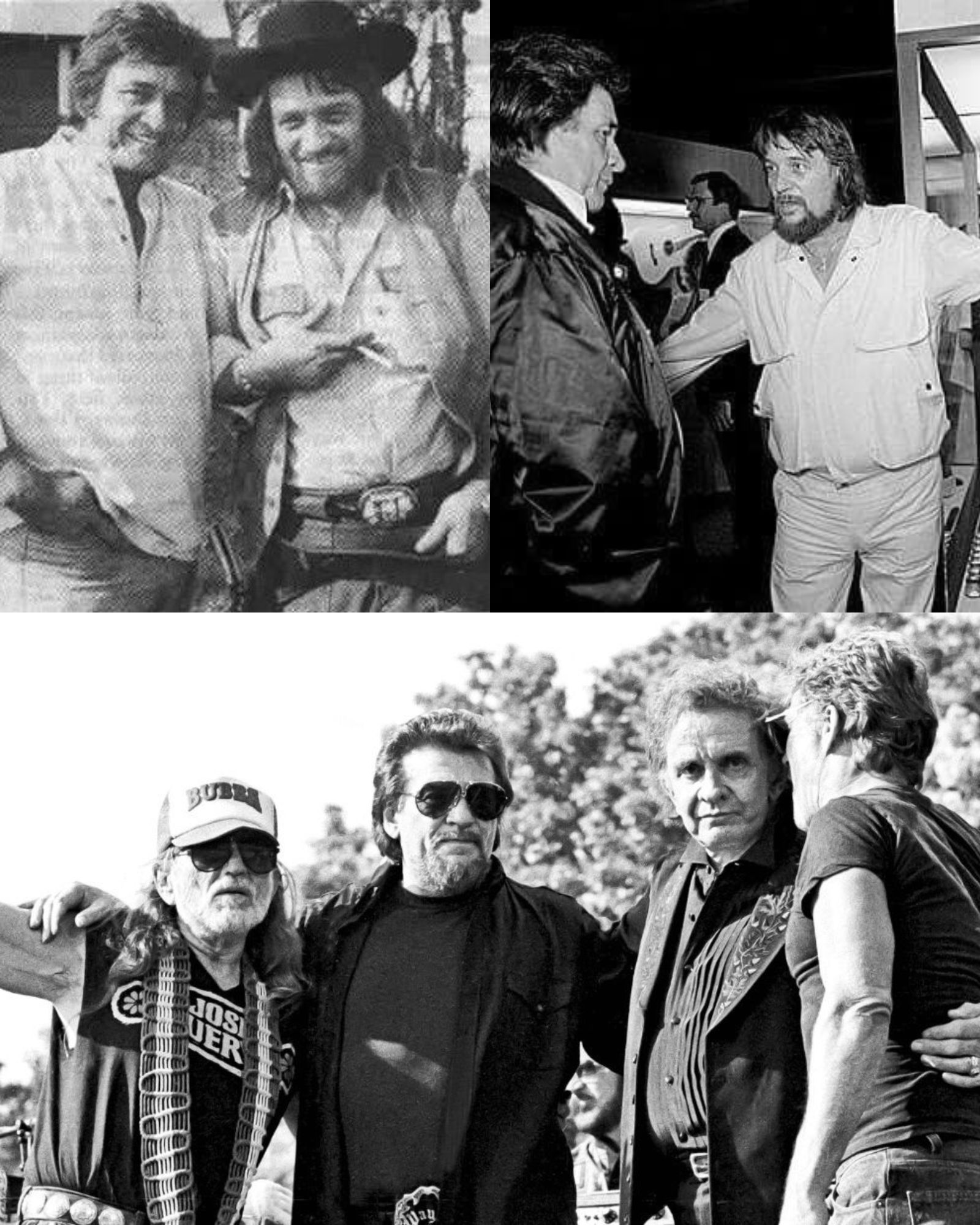
In the mid-1980s, Johnny Cash joined Willie Nelson, Waylon Jennings, and Kris Kristofferson to record the album Highwayman, released in 1985.
The four performers were already towering figures in American country music. Each had a distinctive voice, a remarkable catalog, and a history of following a personal musical path.
For the album, the group returned to “Big River.”
This time, the arrangement divided the storytelling among all four singers. Willie Nelson handled the opening journey through Minnesota and Iowa. Kris Kristofferson continued the pursuit through St. Louis and Memphis.
Then came a verse many listeners had never heard on the original single.
Waylon Jennings sang the missing Natchez verse.
Waylon Jennings delivered the account of a weary traveler leaving town in the rain, bringing a different voice to a piece of Johnny Cash’s original story.
Johnny Cash then took the lead again as the song traveled toward Baton Rouge and New Orleans.
It was more than another recording of an old country favorite. The four singers had given the story room to unfold, and a passage once omitted for length had found a place in the finished performance.
The Remarkable Compliment in 1991
Six years later, the story gained another memorable chapter.
During a 1991 interview with New Zealand broadcaster Paul Holmes, the four Highwaymen were asked to name the greatest country songs ever written.
It was a difficult question for four musicians who had spent their lives writing, recording, and performing extraordinary songs.
Kris Kristofferson answered by naming Johnny Cash’s “Big River.”
Kris Kristofferson went even further, suggesting that the composition might be the finest song ever written, country or otherwise.
And Johnny Cash was sitting right beside Kris Kristofferson.
Johnny Cash responded with visible appreciation, acknowledging how overwhelming it was to hear such praise for a song Johnny Cash had written.
The moment offered a rare glimpse of the respect these four musicians held for one another. Kris Kristofferson was not praising a distant musical hero. Kris Kristofferson was honoring a friend and fellow performer sitting only inches away.
A Song That Found Its Way Back
There is something fitting about the history of “Big River.”
The song tells the story of someone traveling from town to town, searching for something that remains out of reach. And one part of that musical journey spent years outside the best-known recording.
When Waylon Jennings sang the Natchez verse with The Highwaymen, a missing piece returned to the story in a new voice.
For fans who grew up listening to Johnny Cash, the 1985 recording offers a special reason to revisit an old favorite. Listen closely to Waylon Jennings’s verse, and the journey down the Mississippi River becomes a little longer, a little sadder, and a little more complete.
Nearly 30 years after Johnny Cash first recorded the song, four country legends helped preserve the full story—and Waylon Jennings made sure that the forgotten stop in Natchez could be heard again.