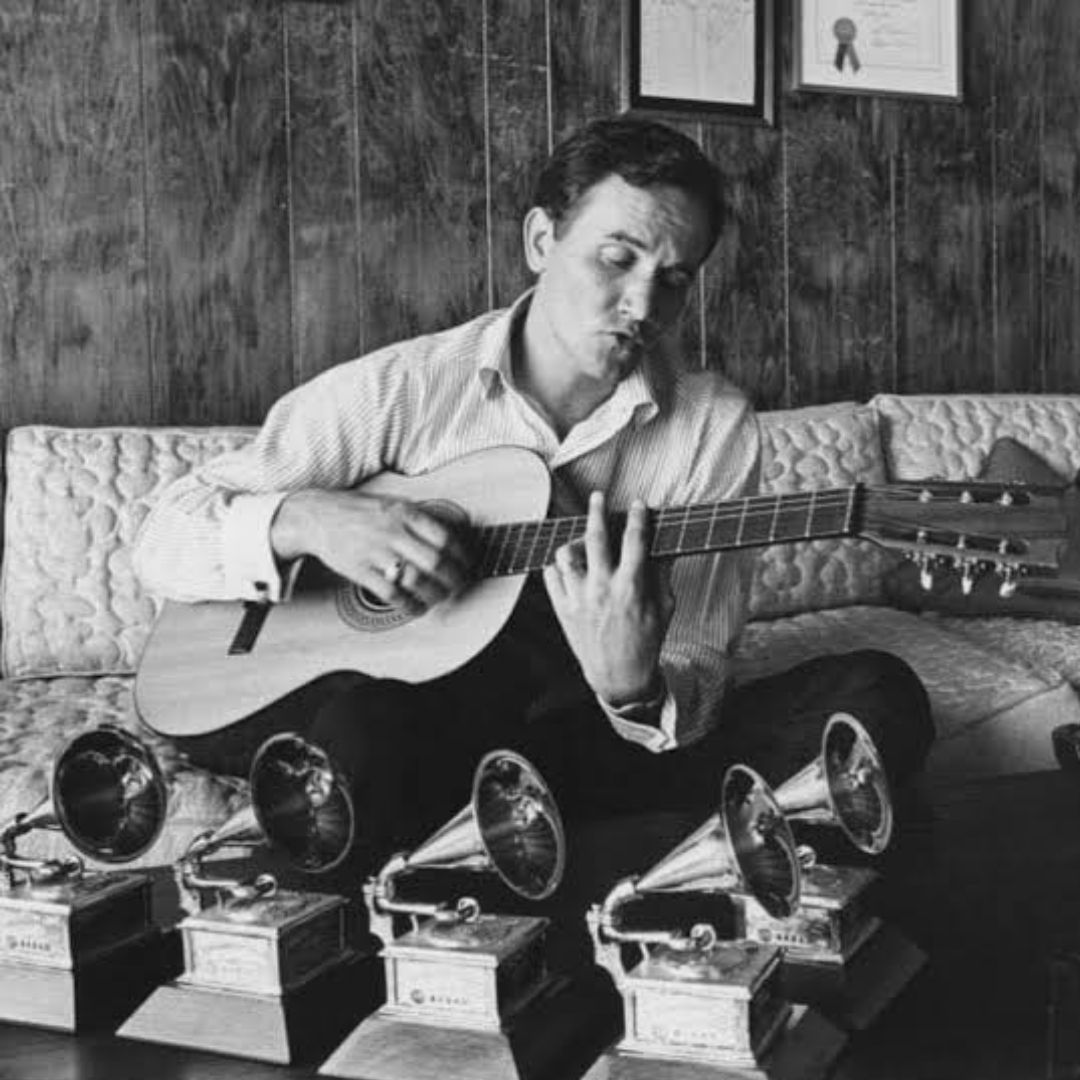
Five words. That is all it took. “Trailers for sale or rent” was nothing more than a hand-lettered advertisement, the kind of sign that hung on barns, fences, and lot gates all over America in 1964. Most people who drove past it never thought about it again. Roger Miller turned it into the opening line of “King of the Road,” the song that went to No. 1 on the country chart, crossed over to No. 4 on the pop chart, and won him five Grammy Awards.
The story of how a throwaway sign became one of the most recognizable songs in American music is a story about how Roger Miller listened to the world. Where other people saw words meant to sell something, he heard a character.
A Sign on the Side of a Barn
Roger Miller was already on a roll when he saw it. “Dang Me” had become a surprise No. 1 hit in 1964, and the singer who had recently been playing for a handful of people in half-empty clubs was suddenly back on the road, touring hard.
In the version he told most often, he was driving at night on his way to Chicago when he spotted the sign hanging on the side of a barn. The words stuck in his head and would not go away.
Here is the honest part, the part a longtime fan will appreciate: Roger Miller never told this story the same way twice. On different nights and in different interviews, he placed that sign outside Chicago, somewhere in Indiana, and even in Kitchener, Ontario. In Idaho, people still repeat a story that the sign stood in a trailer lot in Nampa. Roger loved an audience, and more than one writer has suspected he let each town believe the song started there. The sign itself was real. Exactly where it stood, he took with him.
Written on an Airline Credit Card Application
Roger did not reach for a notebook. He grabbed what he had: a West Coast Airlines credit card application. He folded it over and wrote the line down, along with a few more lines that would become the bones of the first verse.
That early draft still exists, and it shows a songwriter working, not just getting lucky. Writer Brian Carpenter, who studied the draft for the journal Southern Cultures, noted how Roger kept polishing the words. A proper “I’ve got” became a looser, more natural “I ain’t got,” the way the man in the song would actually talk. Carpenter also pointed out how many hard “R” sounds are packed into that single sign, and suggested it may have been the music of the words, not just their meaning, that caught Roger’s ear.
Six Weeks, Not Four Minutes
This is what makes the story remarkable. Roger Miller liked to work fast. He claimed he wrote “Dang Me” in about four minutes. But he could not rush this one.
He carried the idea for weeks. Accounts differ on how long, anywhere from two to six weeks depending on who tells it, but everyone agrees it took far longer than usual for him. He was building a whole person out of a few words on a sign: a drifter with almost no money, who sleeps wherever a little honest work will pay for a room, and who still walks through the world like he owns the highway.
Even the title came from somewhere unexpected. According to one account, a promoter named Shelly Snyder lost his patience after Roger asked him for a favor and snapped back, sarcastically asking if Roger thought he was the king of the road. Roger kept that one too.
The Little Wooden Hobo in Boise
The song finally came together in Boise, Idaho. To help it along, Roger bought a small statuette of a hobo at the airport gift shop. In his own words, he wanted it to “induce labor.” He set it in front of him and stared at it until the rest of the song arrived.
Idaho historian Rick Just has written that Roger himself, at a 1972 press conference, said he wrote the song while staying at the Hotel Boise. Bob Weisenberger, who managed the Boise country station KGEM, later recalled sitting in a hotel room listening to Roger play with a young disc jockey from the station who called himself Marty Martin. Years later, the world would know that disc jockey as Boxcar Willie.
From a Hotel Room to the Top of the Charts
Roger Miller recorded “King of the Road” on November 3, 1964. The session was beautifully simple: Bob Moore’s walking bass, Pig Robbins on piano, and the famous finger snaps, supplied by Roger himself and his publisher, Buddy Killen.
It became his second No. 1 country hit, reached No. 4 on the Billboard Hot 100, and topped the chart in Britain. At the Grammy Awards the song alone won five trophies, and Roger took home another that night for the album it came from, The Return of Roger Miller. Not bad for five words on a barn.
He Kept Both
Roger Miller never threw away the folded credit card application, and he never threw away the little hobo. He put them together in a shadow box that he built himself.
On November 6, that shadow box goes on display at the Country Music Hall of Fame and Museum in Nashville as part of a new exhibit, Roger Miller: Wit, Wisdom, and Wonder, which runs until March 2028. Visitors will be able to stand in front of the very scrap of paper where a roadside sign first became a song.
Roger Miller died in 1992 at just 56 years old. But every time that piano starts and those fingers snap, those five words are on the road again.
Do you remember where you were the first time you heard “King of the Road”?