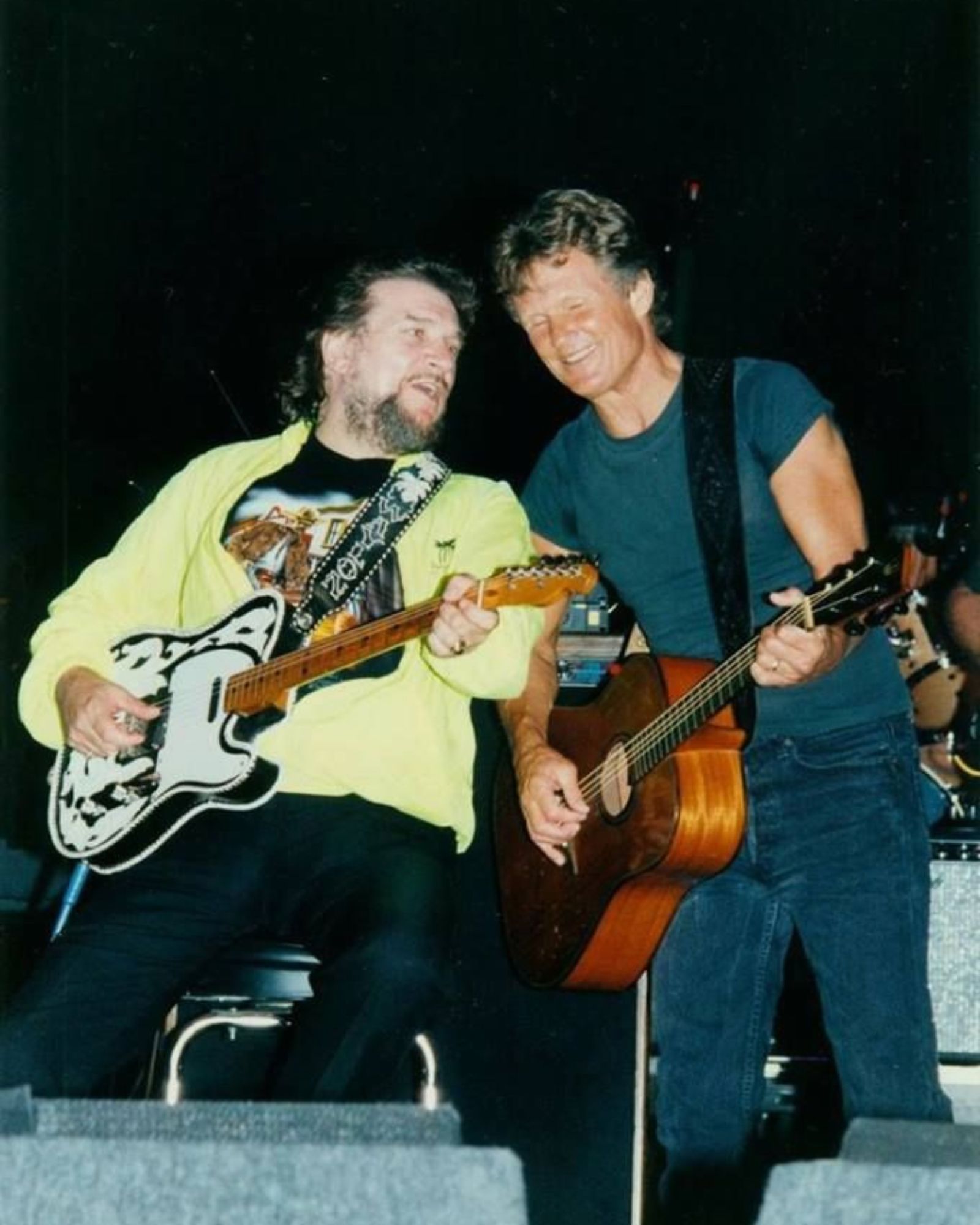
When Waylon Jennings died on February 13, 2002, at his home in Arizona, country music lost one of its most uncompromising voices. Waylon Jennings was 64, and tributes came from musicians who had spent decades admiring his songs, his independence, and his refusal to follow Nashville’s rules.
But Kris Kristofferson remembered something different.
“Waylon Jennings was an American archetype, the bad guy with the big heart.”
It was a simple description from a man who had known Waylon Jennings long enough to understand both sides of his personality. Kris Kristofferson had admired Waylon Jennings before they became friends, shared stages with him during the Highwaymen years, and discovered firsthand just how stubborn his old friend could be.
And there was a reason those words meant more coming from Kris Kristofferson.
Kris Kristofferson Was a Fan Before He Was a Friend
Years before the Highwaymen became one of country music’s most celebrated groups, Kris Kristofferson was working as a janitor at a Nashville recording studio.
One day, Kris Kristofferson heard Waylon Jennings singing a demo of Harlan Howard’s “Green River.” The power and intensity of Waylon Jennings’ voice made an immediate impression.
When Kris Kristofferson recalled that experience after Waylon Jennings’ death, he explained that hearing the performance had made him a lifelong admirer.
That memory matters because Kris Kristofferson’s respect for Waylon Jennings began with the music, long before the two men shared a stage as equals.
Kris Kristofferson recognized something genuine in Waylon Jennings’ singing. The same fierce independence that made Waylon Jennings difficult for Nashville executives to control also gave his records their unmistakable character.
Two Outlaws Who Didn’t Always Agree
In 1985, Waylon Jennings and Kris Kristofferson joined Johnny Cash and Willie Nelson to form the Highwaymen. Their recordings and concerts brought together four enormously different personalities, each accustomed to doing things his own way.
But friendship did not mean agreement.
During one Highwaymen performance, Kris Kristofferson made political remarks from the stage that angered Waylon Jennings. Waylon Jennings believed that a group performance was not the proper place for one member to express views the others might not share.
The disagreement became heated enough that Waylon Jennings later acknowledged they had nearly come to blows.
It is a remarkable detail in their friendship. These were not two men pretending to agree for the sake of a successful touring act. They had strong convictions, strong personalities, and occasionally strong disagreements.
Jessi Colter later explained that Waylon Jennings and Kris Kristofferson understood one another despite those differences. Their arguments did not erase the affection between them.
That history gives Kris Kristofferson’s words in February 2002 a deeper meaning. He was not remembering a friend who had always been gentle or easy to work with. He was remembering the whole man.
The Heart Behind the Black Hat
Waylon Jennings had spent years building a reputation as one of country music’s toughest rebels.
He challenged the Nashville recording system, insisted on greater artistic control, questioned industry awards, and even declined to attend his own Country Music Hall of Fame induction in 2001.
In a 1992 interview with the Associated Press, Waylon Jennings made clear that he expected honesty from people and would stand his ground when anyone interfered with his music.
But Kris Kristofferson understood that Waylon Jennings’ toughness was only part of the story.
In his tribute, Kris Kristofferson emphasized how deeply Waylon Jennings cared about Jessi Colter, children, music, and his country.
Those were not abstract qualities. They were the things Kris Kristofferson believed mattered most to his friend.
Waylon Jennings could be fiercely protective of his independence while remaining deeply attached to the people and values he loved. His hard exterior did not cancel out his tenderness.
The Joke Kris Kristofferson Remembered After Waylon Jennings Died
There was another part of Waylon Jennings that Kris Kristofferson wanted people to remember: his humor.
On February 13, 2002, as friends and fellow musicians mourned Waylon Jennings, Kris Kristofferson spoke about the pleasure of working beside him and hearing some of the funniest remarks he had ever encountered.
Then Kris Kristofferson offered a final joke, imagining what Waylon Jennings might be telling Johnny Cash, who was still alive:
“See, I told you I was sicker than you.”
It was a dark little joke, but one that reflected the sharp humor Kris Kristofferson remembered so fondly.
Even while mourning Waylon Jennings, Kris Kristofferson could picture his friend delivering one last mischievous line.
That may be the most revealing part of the tribute.
Kris Kristofferson did not ignore Waylon Jennings’ stubbornness, rebelliousness, or difficult moments. He had experienced some of them personally. But after decades of friendship, arguments, recording sessions, and concerts, those were not the things he chose to emphasize.
He remembered the man who cared deeply, sang with extraordinary conviction, stood by his principles, and could still make an old friend laugh.
For Kris Kristofferson, the black hat never told the whole story of Waylon Jennings. The big heart did.