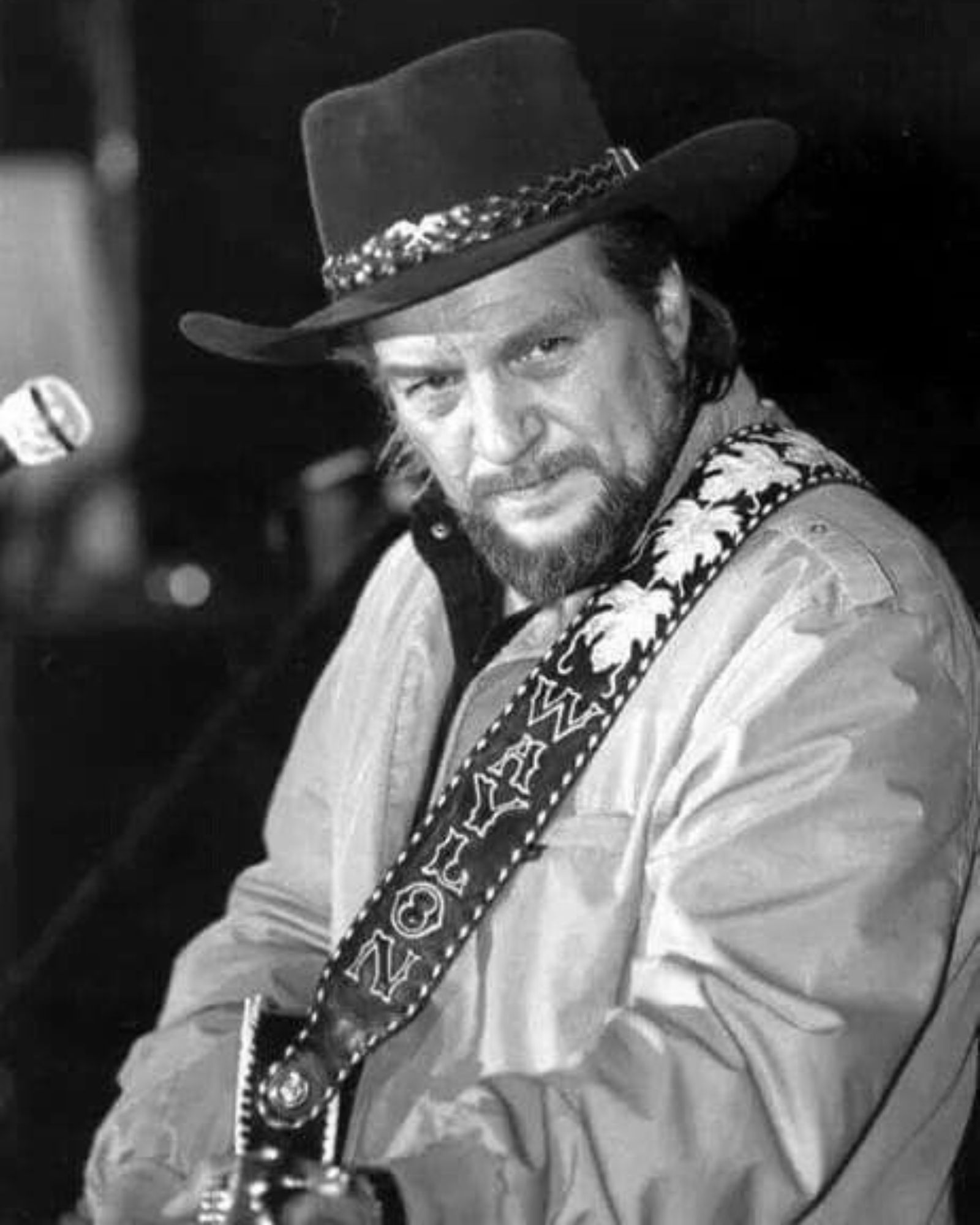
On March 23, 2002, Nashville’s Ryman Auditorium hosted a memorial that ended in a way few country music fans would forget.
Waylon Jennings had died on February 13 at home in Chandler, Arizona. Waylon Jennings was 64 years old, leaving behind a career that had changed country music and influenced generations of performers.
More than a month later, family members, longtime friends, fellow musicians, and fans gathered to honor the man who had helped define outlaw country.
There would be familiar songs, personal memories, and performances from musicians who admired Waylon Jennings. But the final voice heard during the two-hour service would belong to Waylon Jennings himself.
A Guitar, a Cowboy Hat, and the Ryman Stage
The stage carried unmistakable reminders of Waylon Jennings.
A black backdrop displayed the large silver “W” used during Waylon Jennings’ touring years. A black guitar stood on display with Waylon Jennings’ cowboy hat resting above it. Red rose petals lay nearby.
In the audience, fans wore black cowboy hats and shirts celebrating the singer whose music had become part of their lives.
The Ryman Auditorium was a fitting location. Once home to the Grand Ole Opry, the historic Nashville venue had witnessed generations of country music history.
Waylon Jennings had spent much of the 1970s challenging Nashville’s expectations. Alongside Willie Nelson and other musicians, Waylon Jennings pushed for greater artistic control over recordings and musical direction.
Now the Ryman was honoring that independence.
Shooter Jennings and the Musicians Who Came to Say Goodbye
Waylon Jennings’ son, Shooter Jennings, performed with the rock band Stargunn.
Shooter Jennings told the audience that Waylon Jennings had taught the younger musicians how to rock, promising that the band would demonstrate what they had learned.
It was an appropriate tribute to a father whose music had never fit neatly into one category.
Travis Tritt performed “Lonesome, On’ry and Mean,” celebrating the determination that had made Waylon Jennings such a distinctive performer.
Kris Kristofferson, Billy Ray Cyrus, and David Lee Murphy were also among the participating artists.
Reverend Will Campbell delivered the eulogy. Will Campbell was a writer and civil rights advocate who had once worked as Waylon Jennings’ cook, giving the tribute a connection beyond the music business.
Waylon Jennings’ widow, Jessi Colter, attended alongside friends and colleagues, including producer Cowboy Jack Clement.
Video presentations revisited different periods of Waylon Jennings’ career, while messages from admirers such as Paul Simon, Graham Nash, and Neil Diamond were shared.
The Final Song Was “The Dream”
After approximately two hours of performances and remembrances, the memorial reached its closing moment.
A recording of Waylon Jennings singing “The Dream” played for the audience.
Associated Press coverage at the time described “The Dream” as the last song Waylon Jennings had written and recorded. Later RCA publicity identified the recording more cautiously as one of the singer’s final recordings.
The distinction matters, but the significance of the moment remains unchanged.
Rather than ending the memorial with another musician performing a familiar Waylon Jennings hit, the gathering closed with a recording of Waylon Jennings singing a song from the final chapter of life.
The lyrics looked back on experience, expectations, and the difference between imagining a life and actually living it.
When Waylon Jennings’ recorded voice reached the audience, people called out blessings and declarations of love.
The responses were reported by journalists covering the service. The audience was not merely listening to a recording. Fans were offering a final goodbye.
What Happened to “The Dream” After the Memorial?
The story did not end at the Ryman.
On August 19, 2003, RCA released I’ve Always Been Crazy: A Tribute to Waylon Jennings, an album featuring musicians from country, rock, and other musical traditions.
The collection included performances by Travis Tritt, John Mellencamp, Dwight Yoakam, Alison Krauss, Hank Williams Jr., Jessi Colter, and Metallica frontman James Hetfield.
Shooter Jennings and Stargunn contributed a version of “I’ve Always Been Crazy.”
But the album’s fifteenth and final track was different from the others.
It was “The Dream,” performed by Waylon Jennings.
The recording that had helped close the Ryman memorial was now available to listeners who had never attended the service.
That final track gave the tribute album a personal connection to the farewell in Nashville. After hearing other musicians interpret Waylon Jennings’ songs, listeners could finish the record with Waylon Jennings’ own voice.
A Farewell That Needed No More Words
Waylon Jennings had spent decades recording songs about independence, mistakes, loyalty, and living according to personal convictions.
At the Ryman, friends honored those qualities through music and memories. Shooter Jennings represented the next generation, while longtime colleagues remembered an artist who had refused to surrender creative control.
Yet the moment remembered most vividly from that March evening was remarkably simple.
A guitar and cowboy hat remained on display. A recording played. And fans answered the voice of Waylon Jennings with words of love.
More than a year later, “The Dream” would close the tribute album, preserving the song that had given the Ryman gathering its final moment.