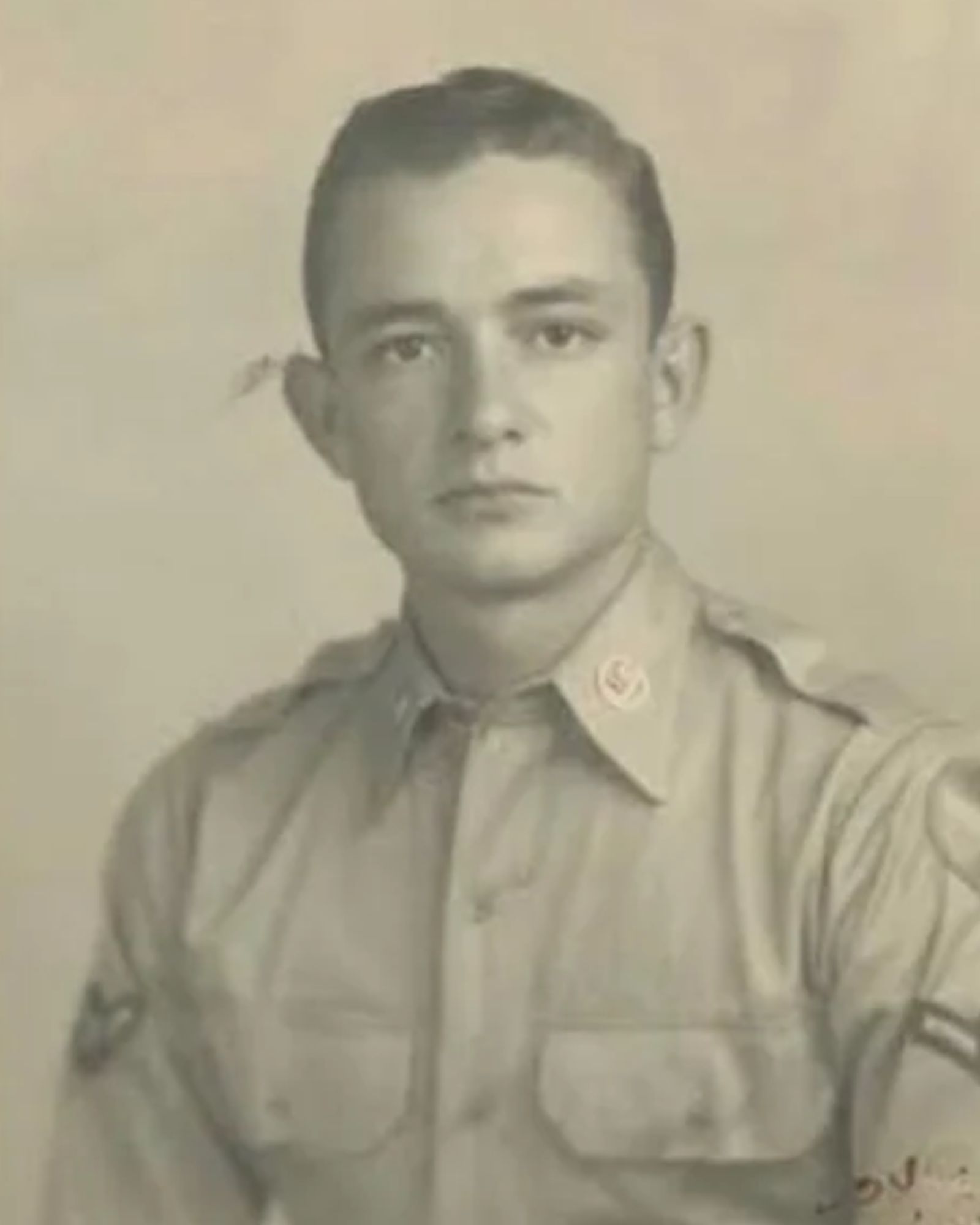
Long before the black suit, the prison concerts and the voice that sounded like it came up from the ground, Johnny Cash had two jobs that seem to belong to two different men. In one, he was a Cold War radio operator so skilled that the Air Force trusted him with Soviet military traffic. In the other, he was a door-to-door salesman in Memphis who could barely sell a thing.
The second job is the one that nearly kept him from music. It is also the one that pushed him onto the front steps of Sun Records.
The Ace of Landsberg
Johnny Cash enlisted in the Air Force on July 7, 1950, shortly after the Korean War began. After training in Texas, he was assigned to the 12th Radio Squadron Mobile of the Air Force Security Service at Landsberg, West Germany. His job was to sit with headphones on and copy Soviet Army Morse code transmissions, which came fast and often buried in noise.
He was good at it. Years later, Johnny Cash described himself plainly:
“I was the ace. I copied the first news of Stalin’s death.”
That was March 1953. Whether he was truly the very first American to catch that message is impossible to prove, but it is the account he gave in his own autobiography. In his off hours in Germany, he bought a cheap guitar, formed a small band with other airmen and began writing songs.
A Salesman Who Wouldn’t Push
Johnny Cash left the Air Force in July 1954. He married Vivian Liberto and the couple settled in Memphis, where his older brother Roy already lived. With a baby on the way, he needed work fast, and he found it at the Home Equipment Company on Summer Avenue, selling appliances door to door.
It did not go well. His daughter Rosanne Cash later called him the single worst appliance salesman who ever lived. In her own writing, she suggested the reason was simple: her father did not like talking people into things they did not want. The family lived in half of a duplex on Tutwiler Street, a short walk from the store and about five miles from a small studio at 706 Union Avenue.
The Porch on His Sales Route
The sales route gave Johnny Cash something the job itself could not. On his rounds one day, he came across an elderly man playing music on his front porch and stopped to listen. The man was Gus Cannon, who had led one of Beale Street’s best-known jug bands and had made records back in the 1920s.
Johnny Cash ended up playing guitar with him. Cannon is now remembered as one of the young salesman’s early musical mentors in Memphis, a living link to the old blues and medicine-show songs that ran underneath so much of the music Cash would later make.
There was another surprise. Through his brother Roy, Johnny Cash met two mechanics who played music, guitarist Luther Perkins and bassist Marshall Grant. The three began rehearsing, and his boss at the appliance company sponsored them for a short Saturday spot on radio station KWEM in West Memphis, Arkansas. The salesman could not move appliances, but his employer was willing to put his voice on the air.
Turned Away From Sun Records
The studio on Union Avenue belonged to Sam Phillips, and it was the place every hopeful singer in Memphis wanted to be. Johnny Cash tried the direct route first. He knocked on the door and was turned away. He called back three or four times asking for an audition. Each time, the answer was no.
So he tried something else. He found out what time Sam Phillips arrived for work. One morning he went down with his guitar and sat on the studio steps, waiting.
When Sam Phillips walked up, Johnny Cash introduced himself. The producer already knew who he was.
“You’re the one that’s been calling.”
Johnny Cash later said he knew he was taking a chance. Phillips could have sent him away again. Instead, he invited him inside to listen.
What Came Through the Door
Accounts of the exact sessions vary, but the outline is clear. Johnny Cash leaned toward gospel at first, and Sam Phillips did not think gospel would sell. What caught his ear was a song called “Hey Porter,” which Cash had reworked from something he wrote during his Air Force years. Phillips wanted a sadder love song for the other side of the record, and Cash came back with “Cry! Cry! Cry!”
The single was released on Sun in the summer of 1955. It was Sam Phillips who started calling him Johnny and named the group Johnny Cash and the Tennessee Two. Before long, the record’s success earned them spots on the road with Elvis Presley and on the Louisiana Hayride, and Johnny Cash left the appliance business behind for good.
It is a strange path when you look at it whole. A young man trained to catch faint signals through static in a German radio hut came home and could not convince a single housewife to buy a refrigerator. But he kept listening for the one place that might hear him, and when the phone calls failed, he simply showed up and waited on the steps.
Do you remember the first time you heard “Hey Porter” or “Cry! Cry! Cry!” on the radio? We’d love to hear your memories of early Johnny Cash.