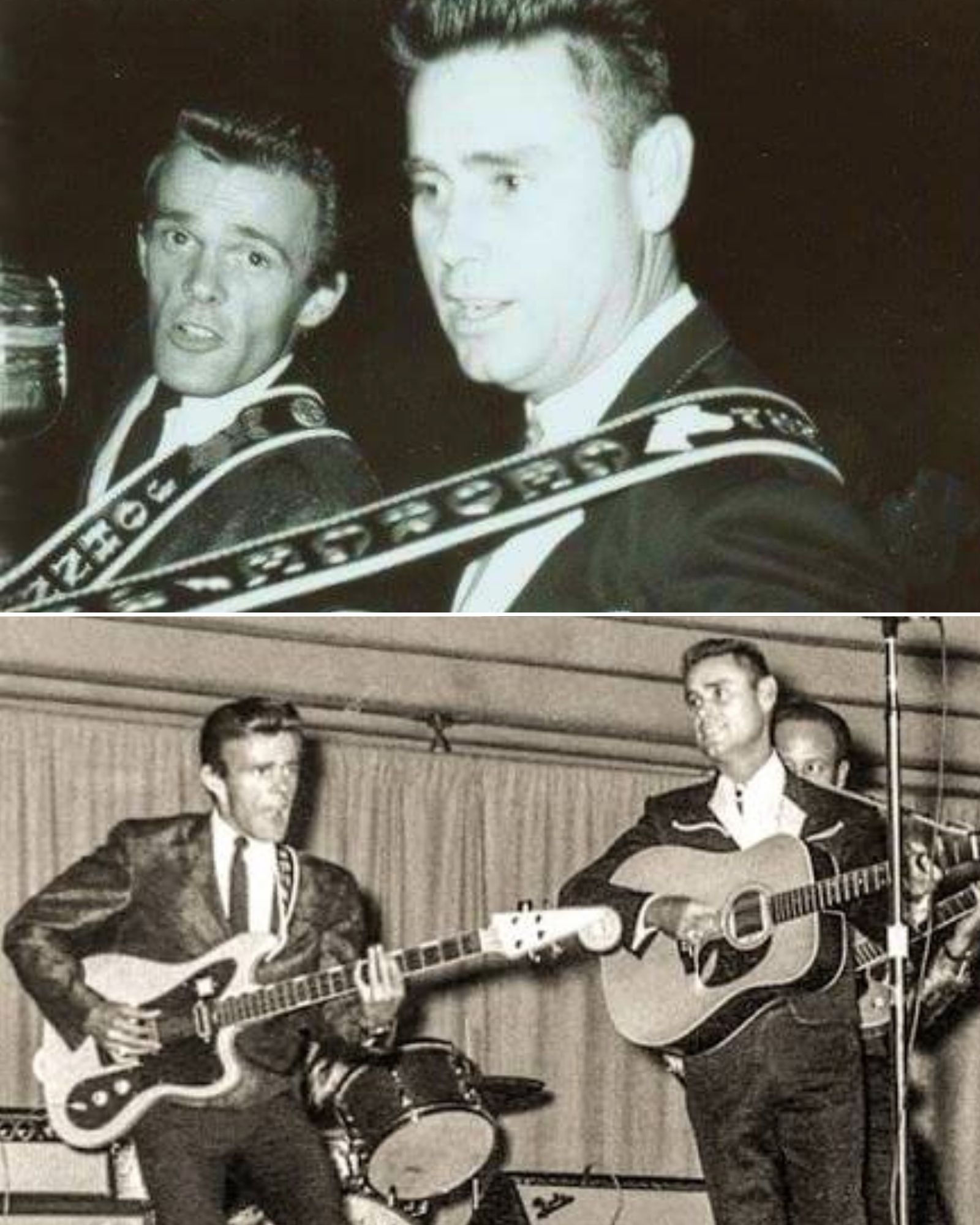
In February 2003, George Jones helped arrange a final resting place for someone who had once traveled the road with him. Johnny PayCheck had died at 64, and George Jones donated a burial plot beside the one reserved for himself.
The gesture connected two very different chapters of a friendship: the years when a young musician wanted a place in George Jones’s band, and the day George Jones stood beside that musician’s grave.
A young musician who wanted to go on the road
Before Johnny PayCheck became a star, Johnny PayCheck worked in the bands of established country singers, including George Jones. It was an apprenticeship familiar to generations of Nashville musicians: learning the work while helping someone else deliver the show.
At the graveside, George Jones remembered meeting Johnny PayCheck in Columbus, Ohio. Johnny PayCheck wanted to travel and work with George Jones.
“I couldn’t leave town without him,” George Jones recalled.
That brief recollection brought the story back to its beginning. Before the hit records and the public reputation, there had been an ambitious musician asking for an opportunity.
The connection continued beyond those early band years. George Jones and Johnny PayCheck later recorded an album together, Double Trouble. For listeners, the record preserved the sound of two distinctive country singers sharing material. Behind the collaboration was a relationship that had begun much earlier, when their positions in the business were different.
The years away from the stage
Johnny PayCheck’s final years were marked by serious respiratory illness. Emphysema and asthma left Johnny PayCheck bedridden in a Nashville nursing home, a considerable distance from the touring life that had once defined the working week.
There is a particular sadness in that change for a performer. Audiences remember movement, familiar introductions, and a voice arriving through a microphone. Illness can leave the person behind those memories living a much quieter daily life.
When Johnny PayCheck died, friends helped with the funeral arrangements. George Jones’s contribution included the burial plot. In a television interview reported at the time, George Jones described that help in straightforward terms.
“Anything of this nature, it’s taken care of by friends.”
The words required little explanation. George Jones treated the arrangements as something friends handled when one of their own could no longer handle anything.
Johnny PayCheck’s voice at the farewell
More than 200 mourners attended the public funeral, including George Jones and Little Jimmy Dickens. Recordings of Johnny PayCheck singing “Old Violin” and “Amazing Grace” were played during the service.
Those selections gave the farewell its own musical character. “Old Violin,” with its image of an instrument feeling worn and set aside, carries an especially difficult resonance when heard after the singer’s death. “Amazing Grace” offered a familiar expression of faith.
For the people gathered there, the recordings also restored something illness had taken away from public life: the opportunity to hear Johnny PayCheck sing.
The story of George Jones’s gift remains moving because the act was concrete. A former bandleader helped provide a place for an old bandmate to rest. At the graveside, George Jones remembered the young musician who had wanted to come along—and the friendship that had lasted long enough for George Jones to be there at the end.