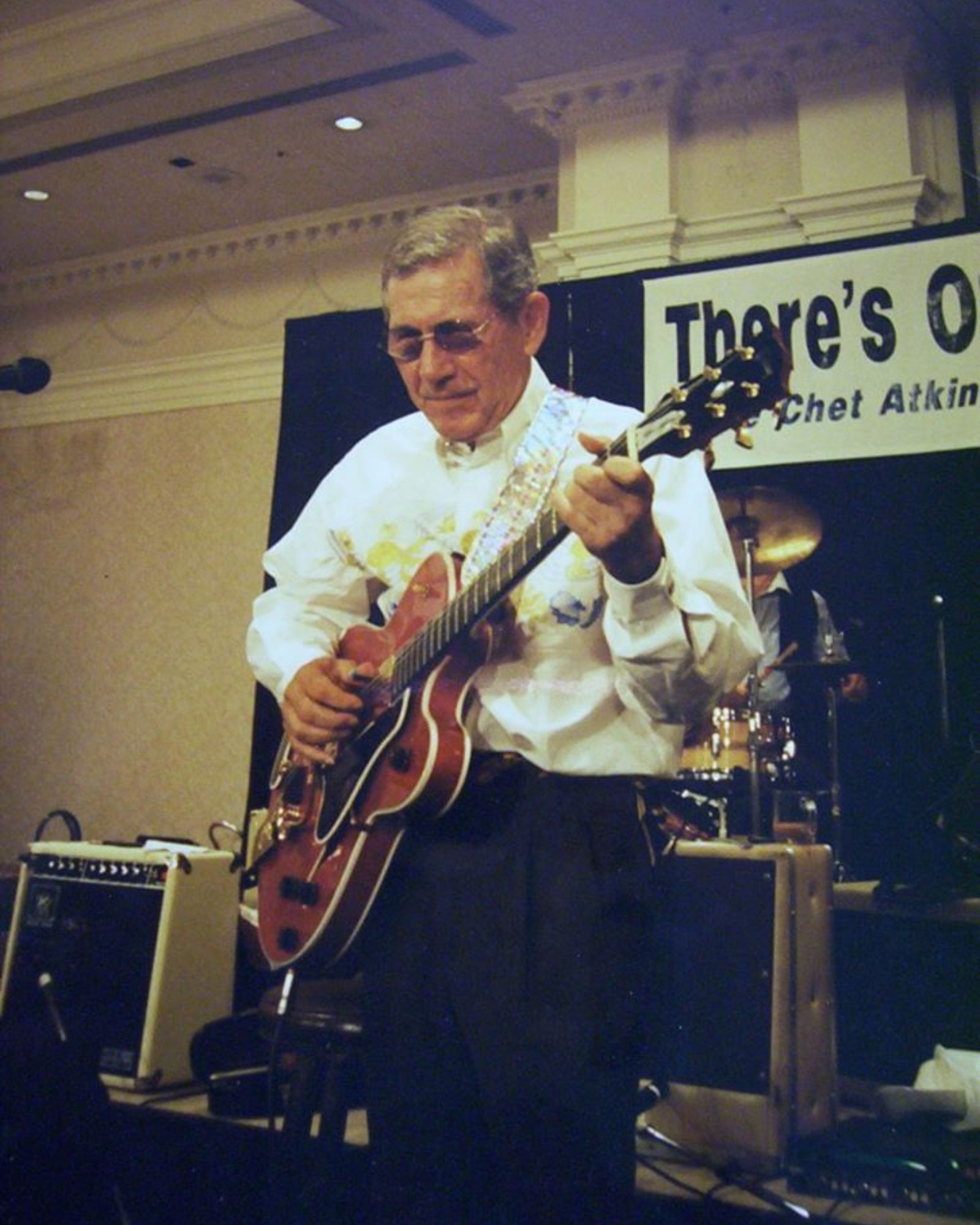
On July 3, 2001, an orange Gretsch guitar stood under a spotlight at Nashville’s Ryman Auditorium. Beside the guitar rested a white Panama hat on a stool.
Both belonged to Chet Atkins.
Three days earlier, the legendary guitarist and producer had died at 77. Now friends, fellow musicians, and country music royalty had gathered at the historic Ryman to say goodbye to the man generations knew as Mister Guitar.
But the most remarkable part of the funeral wasn’t the number of famous people who attended. It was how the service brought together two moments in Chet Atkins’ life, separated by 55 years, on the very same stage.
A Young Guitarist at the Ryman in 1946
During the service, Garrison Keillor recalled a Saturday night in the summer of 1946, when Chet Atkins was still a young musician trying to establish a career.
Red Foley had been performing on the Grand Ole Opry when Red Foley introduced Chester Atkins to the audience. The young guitarist played the traditional tune Maggie on an acoustic guitar.
At a time when audiences often expected guitarists to entertain with flashy playing, Chet Atkins offered something different. The steady bass notes, flowing melody, and understated technique gave the guitar a sound all its own.
Afterward, Minnie Pearl approached Chet Atkins, kissed the young guitarist, and praised the performance. Minnie Pearl told Chet Atkins that the Opry needed a musician like Chet Atkins.
It was an early moment of recognition for a musician who would eventually help shape the sound of Nashville.
The Music Nashville Played at the Funeral
Fifty-five years later, the same Ryman stage became the setting for Chet Atkins’ farewell.
Connie Smith opened the service singing the gospel hymn Farther Along, accompanied by musicians including Marty Stuart.
Eddy Arnold, whose recording career Chet Atkins had helped guide, struggled to maintain composure while remembering a longtime friend.
Paul Yandell, Chet Atkins’ longtime musical partner, performed Windy and Warm and Mr. Sandman. Steve Wariner played Sails, while Vince Gill offered a rendition of Wildwood Flower.
Marty Stuart and fellow musicians also performed The End of the World, a song closely associated with the Nashville production style Chet Atkins had helped develop.
Charley Pride, another artist whose career benefited from Chet Atkins’ support, expressed how much the guitarist and producer had changed Charley Pride’s life.
These were not simply celebrity tributes. The musicians performing that morning represented decades of friendships, recordings, and professional relationships.
The Dolly Parton Visit Garrison Keillor Remembered
One of the most personal moments came during Garrison Keillor’s eulogy.
Garrison Keillor had shared stages with Chet Atkins through the radio program A Prairie Home Companion. Their friendship revealed a side of the reserved guitarist that audiences didn’t always see.
Garrison Keillor remembered Chet Atkins as a man with a remarkably dry sense of humor. Personal letters revealed someone who could joke about aging, performing, and ordinary embarrassments with the ease of a natural storyteller.
Then Garrison Keillor shared a memory involving Dolly Parton.
A few months before Chet Atkins died, Dolly Parton had visited Chet Atkins at home during the final illness. According to Garrison Keillor, Dolly Parton spent about an hour making Chet Atkins laugh through playful conversation and teasing.
Garrison Keillor didn’t reveal everything Dolly Parton had said.
That small recollection offered a different picture of Mister Guitar. Beyond the recording studios, Grammy Awards, and influence on country music, Chet Atkins was a man whose friends knew how much Chet Atkins enjoyed a good laugh.
The Final Words About a Guitar
Near the end of the funeral, Kevin King read a passage reflecting Chet Atkins’ thoughts about growing older and a lifetime spent making music.
Chet Atkins had wondered whether spending so many years producing records and pursuing other interests had taken time away from becoming an even better guitarist.
Yet one detail stood out.
Even when Chet Atkins could no longer play as before, simply holding a guitar, touching the strings, and feeling their vibrations still brought a sense of connection to the instrument.
It was a fitting thought for the man who had spent a lifetime discovering what six strings could do.
In 1946, Chet Atkins had stood on the Ryman stage as a young guitarist receiving encouragement from Minnie Pearl.
In 2001, Nashville returned to that same stage to remember the musician Chet Atkins had become.
And under the Ryman’s lights, the orange Gretsch guitar and white Panama hat remained as simple reminders of the man everyone had come to honor.