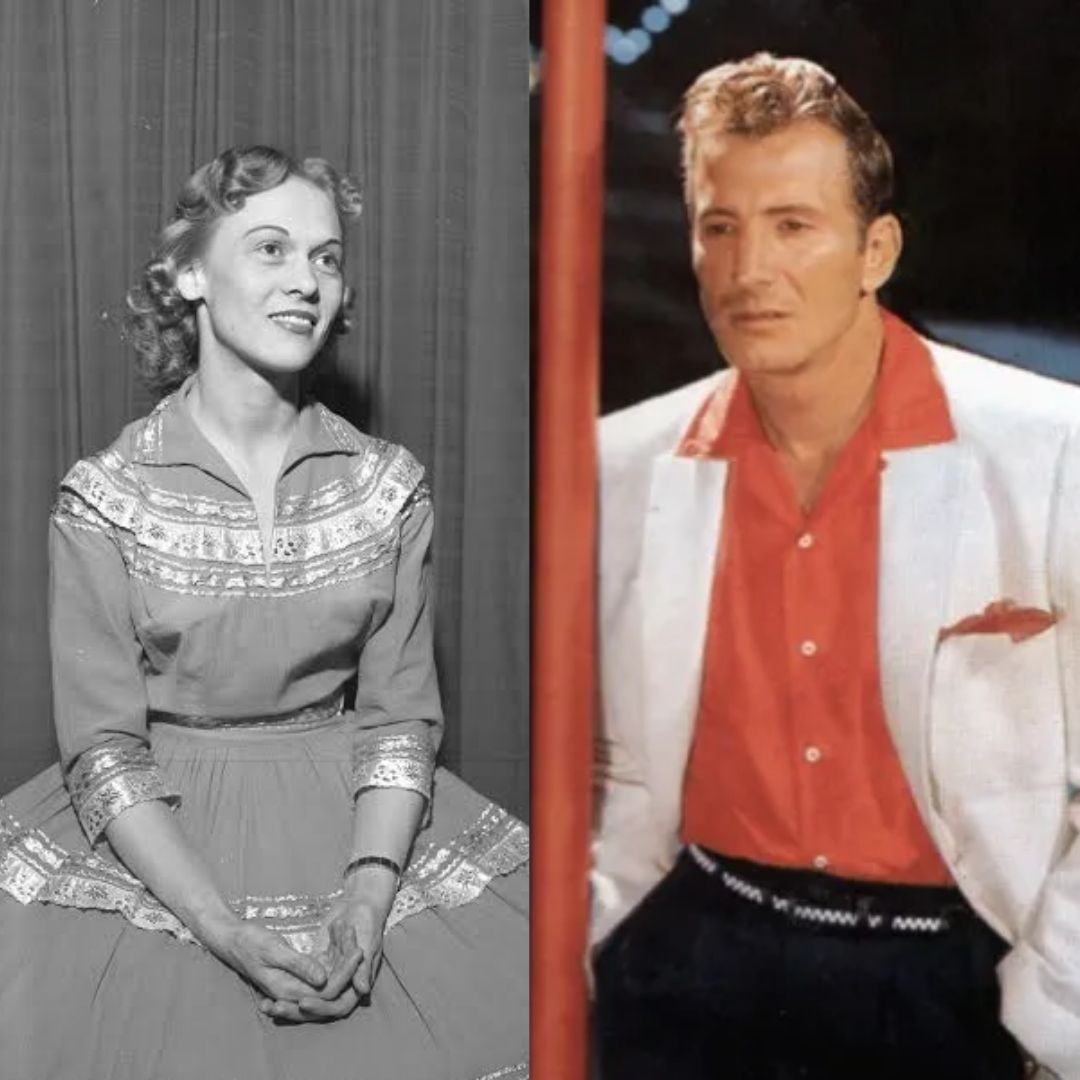
In the summer of 1953, a half-sung, half-spoken song about a soldier and a broken engagement swept across America. “A Dear John Letter” made Jean Shepard a star before she turned 20 and gave Ferlin Husky his first big hit. But the story of how that song reached the radio, and what its success made possible, is one of the most remarkable in the history of the Bakersfield Sound.
Bakersfield in the early 1950s
After the Dust Bowl years, thousands of families from Oklahoma, Arkansas and Texas had moved to California’s Central Valley to find work. By the early 1950s, Bakersfield had a rough, lively honky-tonk scene built by those families and their children. At the center of it was the Blackboard Cafe, where bandleader Bill Woods led the house band. One of his young guitar players was a man named Buck Owens.
Among the regulars were two cousins from Arkansas. Fuzzy Owen had come west at 20, picking cotton by day and playing steel guitar at the Blackboard by night. His cousin, Lewis Talley, sang and played in the same scene.
In early 1953, a hustling songwriter and promoter named Billy Barton, who also recorded as Hillbilly Barton, arrived in town and started Bakersfield’s first local country record labels.
A song nobody heard
Barton had written a song called “A Dear John Letter.” It told a story that soldiers and their families understood all too well, especially with the Korean War winding down: a man serving overseas receives a letter from the girl back home telling him she is marrying someone else.
Barton recorded it first as a duet with Fuzzy Owen and singer Bonnie Owens, the recently divorced former wife of Buck Owens. Bonnie would later marry Merle Haggard. Their version came out on Barton’s small local label, but with almost no distribution, it went nowhere.
Trading a car for a song
Fuzzy and Lewis still believed in the song. Talley made Barton an offer. As he later told it:
“I traded a 1947 Kaiser for it.”
Talley then sold half of his share to Fuzzy for $150. Today the song is credited to Billy Barton, Fuzzy Owen and Lewis Talley.
Ferlin Husky, Ken Nelson and a 19-year-old singer
Ferlin Husky, who was then living in Bakersfield, heard the song and took it to his producer at Capitol Records, Ken Nelson. Husky convinced Nelson to record it with a young Capitol singer named Jean Shepard, a girl from Pauls Valley, Oklahoma, who had grown up near Bakersfield and played bass in an all-female band called the Melody Ranch Girls. The session band included Bakersfield pickers Bill Woods, Lewis Talley, Fuzzy Owen and Tommy Collins.
They recorded it on May 19, 1953. Jean, just 19, sang the words of the letter. Husky spoke the soldier’s lines as he reads it and discovers that the woman he loves is marrying his own brother and wants her picture back. Capitol rushed the record out on June 15.
Number one
“A Dear John Letter” shot to No. 1 on Billboard’s country chart and stayed there for six weeks of a 23-week run. It also reached No. 4 on the pop chart. Jean Shepard became the youngest woman up to that time to have a No. 1 country hit, and the record became the first by a woman country artist after World War II to sell more than a million copies.
Jean was so young that she could not legally tour without a guardian, so her parents made Ferlin Husky her guardian on the road. In her autobiography, she remembered learning the news while riding in a car from Bakersfield to Los Angeles. Buck Owens picked up a copy of Billboard, looked at the chart and tossed it into the back seat to her, asking how it felt to have a No. 1 record.
The pair quickly followed it with “Forgive Me, John,” another Top 10 country hit. Stan Freberg made a parody, and Pat Boone later had a pop hit with the song in 1960.
From a car trade to Merle Haggard
The song’s success changed life for the two cousins who had bet a car on it. Fuzzy Owen and Lewis Talley put the money from “A Dear John Letter” into their own record label and studio, which they called Tally Records.
Around 1961, they met a young singer who had recently been released from prison and was performing at a Bakersfield club. His name was Merle Haggard. Tally Records made his very first recordings, and Fuzzy Owen went on to manage Merle Haggard for the rest of his career. Marty Stuart later said that from the first song Merle ever recorded to the last, Fuzzy was there.
Jean Shepard’s only No. 1
Jean Shepard went on to a remarkable career. She joined the Grand Ole Opry in 1955, placed 73 singles on the country chart and was elected to the Country Music Hall of Fame in 2011. Yet “A Dear John Letter,” the song she recorded at 19, remained the only No. 1 hit of her life.
Not bad for a song that once changed hands for a used car.