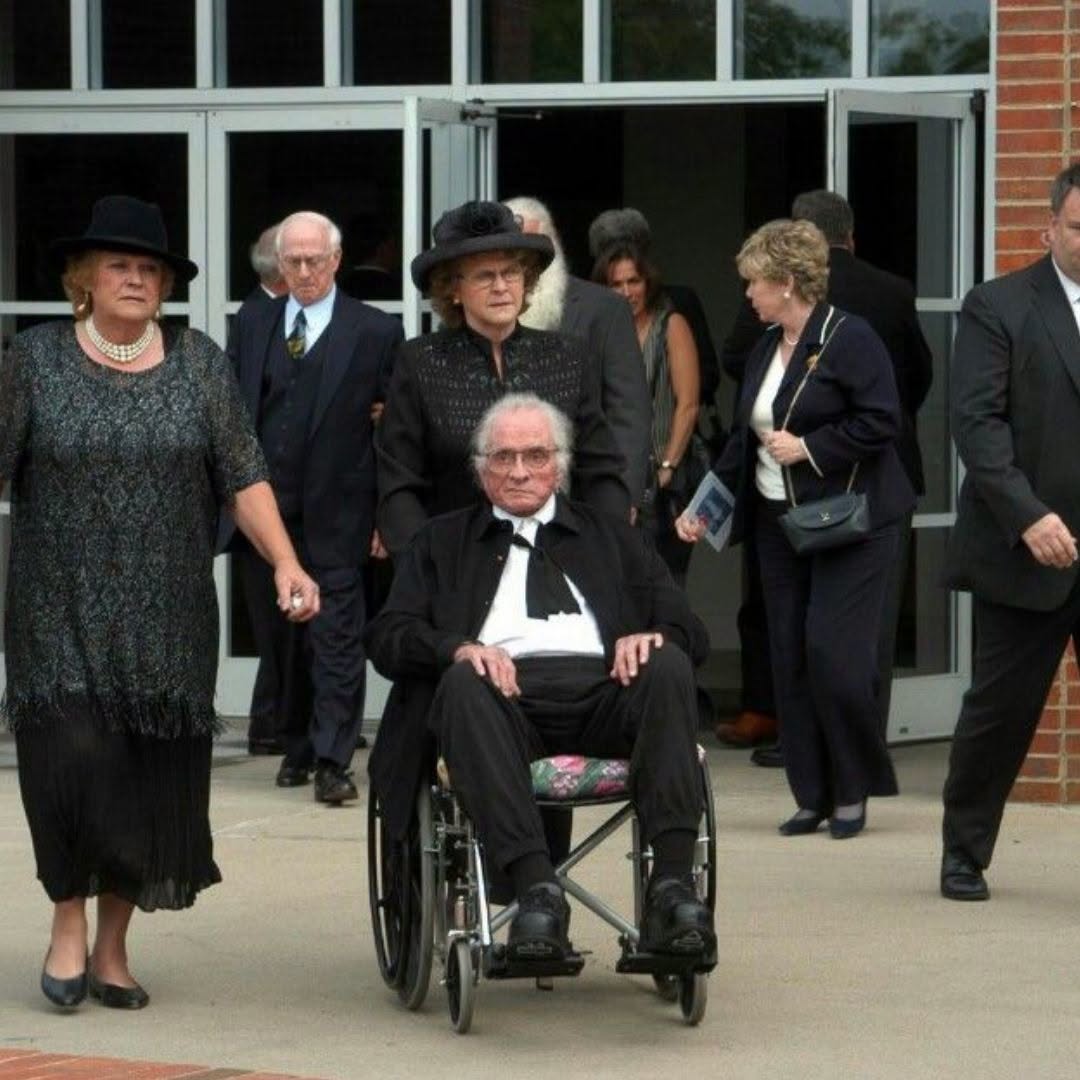
Less than four months after Johnny Cash sat in a wheelchair at June Carter Cash’s funeral, more than 1,000 mourners returned to the same Tennessee church to say goodbye to the Man in Black.
June Carter Cash died on May 15, 2003. At the funeral three days later, Johnny Cash sat quietly in a wheelchair, mourning the woman who had shared 35 years of marriage and decades of music with him.
On September 12, 2003, Johnny Cash died at 71. The loss came just 120 days after June Carter Cash’s death.
But behind the public farewell was another deeply personal story: a song Rosanne Cash had written while worrying about losing her father, a song Johnny Cash almost never recorded with her.
Two Farewells in the Same Tennessee Church
On September 15, 2003, family members, fellow musicians, and longtime friends gathered at First Baptist Church in Hendersonville, Tennessee.
Kris Kristofferson offered a prayer. George Jones, Hank Williams Jr., Vince Gill, and numerous other country music figures attended. Former Vice President Al Gore also paid tribute.
Johnny Cash’s casket was decorated with cotton, corn, and turnip plants, recalling the Arkansas farming country where Johnny Cash had grown up.
Emmylou Harris and Sheryl Crow performed “The Old Rugged Cross” and Bob Dylan’s “Every Grain of Sand.” Larry Gatlin led the congregation in “Oh Come, Angel Band.”
During a film celebrating Johnny Cash’s life, the familiar deep voice filled the church again. For a moment, mourners could hear the man whose songs had accompanied so many chapters of American life.
Then came one of the service’s most personal tributes.
Rosanne Cash Remembered Her Father, Not Just the Legend
Rosanne Cash understood that millions of people were mourning an American musical icon. But for Rosanne Cash, the loss was different.
People had approached Rosanne Cash saying they could not imagine a world without Johnny Cash.
“I cannot begin to imagine a world without Daddy.”
Those words captured the distinction between a public legend and a private family loss.
And only months earlier, Rosanne Cash and Johnny Cash had recorded a song that would make the memory of this moment even more powerful.
The Song Rosanne Cash Never Planned to Record With Johnny Cash
In March 2003, Rosanne Cash released Rules of Travel, an album featuring “September When It Comes.”
Rosanne Cash wrote the lyrics during a period when Johnny Cash’s declining health weighed heavily on her mind. John Leventhal, Rosanne Cash’s husband and producer, discovered the lyrics at home and composed the melody.
John Leventhal believed the song was perfect for Johnny Cash.
Rosanne Cash initially refused. Rosanne Cash worried that inviting her famous father to participate might make listeners believe she was taking advantage of Johnny Cash’s reputation.
John Leventhal continued encouraging the collaboration, explaining that the importance of the song made the duet worthwhile.
Eventually, Rosanne Cash called Johnny Cash and invited him to sing.
Johnny Cash had one condition: he wanted to read the lyrics first.
After reading the words, Johnny Cash agreed.
What Happened Behind the Studio Glass
Rosanne Cash had already recorded her vocals in New York. Because Johnny Cash was not well, Rosanne Cash traveled to Nashville to record his contribution.
On the morning of the session, Johnny Cash was feeling unwell. Rosanne Cash assured her father that recording could be postponed or abandoned.
Johnny Cash insisted on singing.
They went to Johnny Cash’s studio in the woods. As Johnny Cash recorded his part, Rosanne Cash watched from behind the glass.
Years later, Rosanne Cash recalled tears rolling down her face while listening to her father sing.
After finishing, Johnny Cash even offered to record the performance again if John Leventhal considered it insufficient.
Rosanne Cash knew the performance was already enough.
Neither father nor daughter could have known exactly how listeners would eventually remember that recording.
Why “September When It Comes” Became So Meaningful
The song explores aging, changing identity, mortality, and the passage of time. When Johnny Cash died in September 2003, its title took on an unexpected significance.
During the funeral, Al Gore referenced the recording in a tribute to Johnny Cash.
In a 2024 interview, Rosanne Cash reflected on how the recording had become a shared achievement involving Rosanne Cash, Johnny Cash, and John Leventhal.
Rosanne Cash also acknowledged how difficult the song remains to perform without her father.
For longtime fans, “September When It Comes” is more than a rare father-daughter duet. It preserves an intimate collaboration between two accomplished musicians confronting the reality of time passing.
And for Rosanne Cash, it preserves something even more personal: the sound of her father singing words she had written, during a recording session neither would ever forget.
Johnny Cash left behind generations of unforgettable country music. But among those recordings, “September When It Comes” holds a particularly tender place—a daughter’s song, a father’s voice, and a final collaboration that became more meaningful after their last goodbye.