George Jones’ Final Opry Farewell: A Morning the Circle Felt Still
On Thursday, May 2, 2013, the Grand Ole Opry House became more than a performance venue. It became a place of memory, grief, and gratitude. Thousands of people gathered to honor George Jones, the country legend known to generations as The Possum. Some waited through the night. Others arrived before sunrise. They came because George Jones was not just a singer to them; he was a voice that seemed to carry every heartbreak country music could hold.
George Jones had died six days earlier, on April 26, 2013, at age 81, after being hospitalized with a fever and irregular blood pressure. His death marked the end of a career that stretched across decades, but the farewell at the Opry showed how deeply his music had stayed alive in Nashville and beyond.
A Stage Filled With Respect
A wreath hung at the front door of the Opry House, echoing the lyric of George Jones’ signature song, “He Stopped Loving Her Today.” Inside, the service unfolded like a final chapter in country music history. Former First Lady Laura Bush spoke. Governors and Nashville figures stood among the mourners. Artists including Vince Gill, Patty Loveless, Alan Jackson, Ronnie Milsap, Randy Travis, Travis Tritt, the Oak Ridge Boys, Charlie Daniels, Brad Paisley, and others helped carry the music forward one last time.
Then came one of the most moving moments of the day. Vince Gill and Patty Loveless performed “Go Rest High on That Mountain,” and the room seemed to quiet around them. Their duet was steady, tender, and hard to hear without feeling the weight of the moment.
For a few minutes, the Opry sounded less like a show and more like a prayer.
Alan Jackson’s Quiet Salute
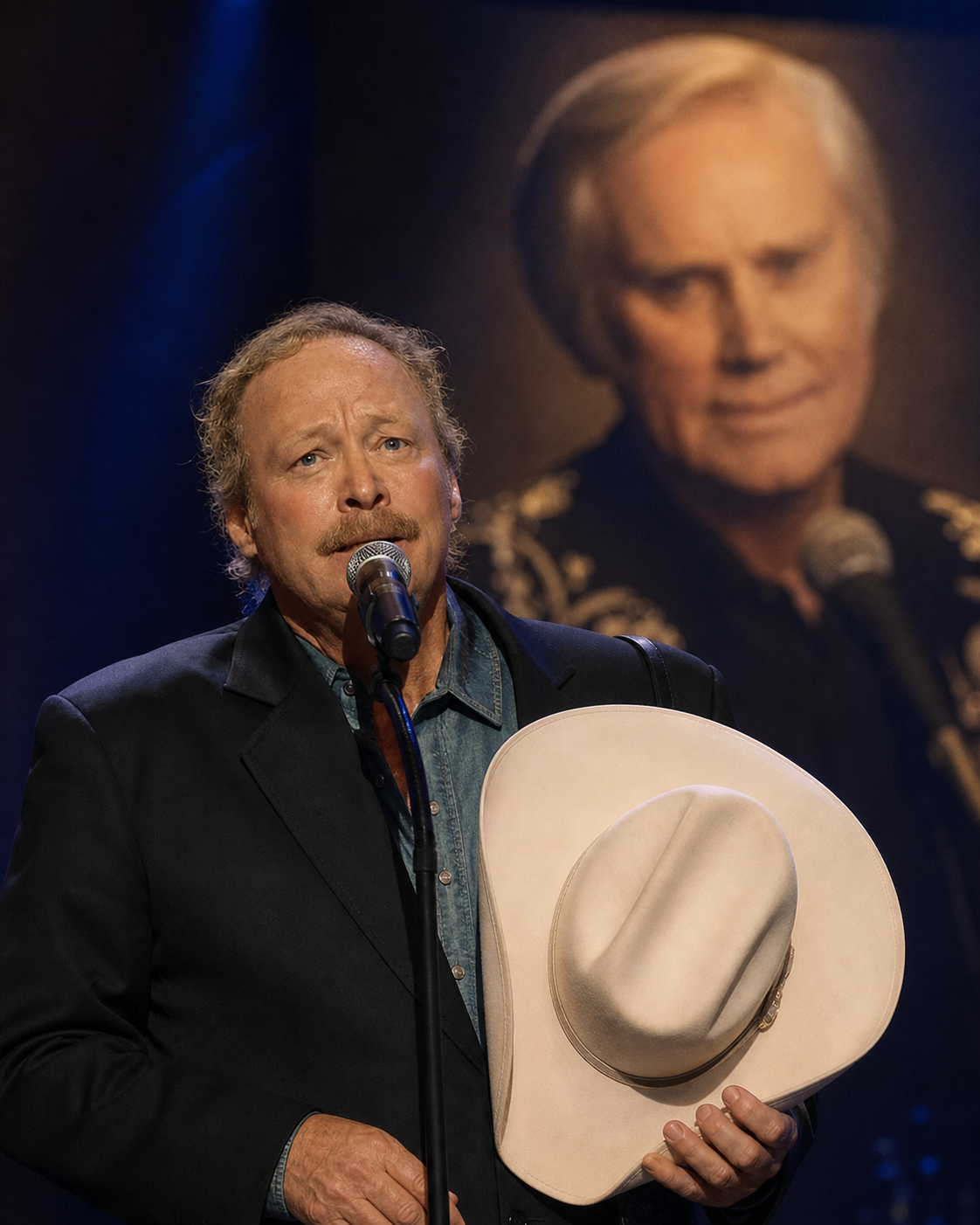
Near the end of the service, Alan Jackson stepped forward to sing “He Stopped Loving Her Today.” It was the song most closely tied to George Jones, and Alan Jackson understood the moment completely. As he sang, he removed his white cowboy hat — a simple gesture, but one that said everything. It was a final salute to a man lying in the casket just below the stage, the man whose voice had shaped country music for more than half a century.
The service lasted almost three hours, but time felt different that day. Every song, every speech, and every silence pointed back to the same truth: George Jones had earned his place in the heart of the Grand Ole Opry.
Home One Last Time
After the ceremony, George Jones’ own recording of “When the Last Curtain Falls” played over the speakers as pallbearers carried his casket off the Opry stage for the final time. He was later buried at Woodlawn Cemetery in Nashville, not far from the Opry circle where his voice had lived for 57 years.
It was a farewell fit for a giant, but also deeply human. The music was grand, yet the emotion was personal. That is what made the day unforgettable. George Jones was gone, but the room carried him out in the only way that made sense: with song, with reverence, and with a silence that said more than words ever could.