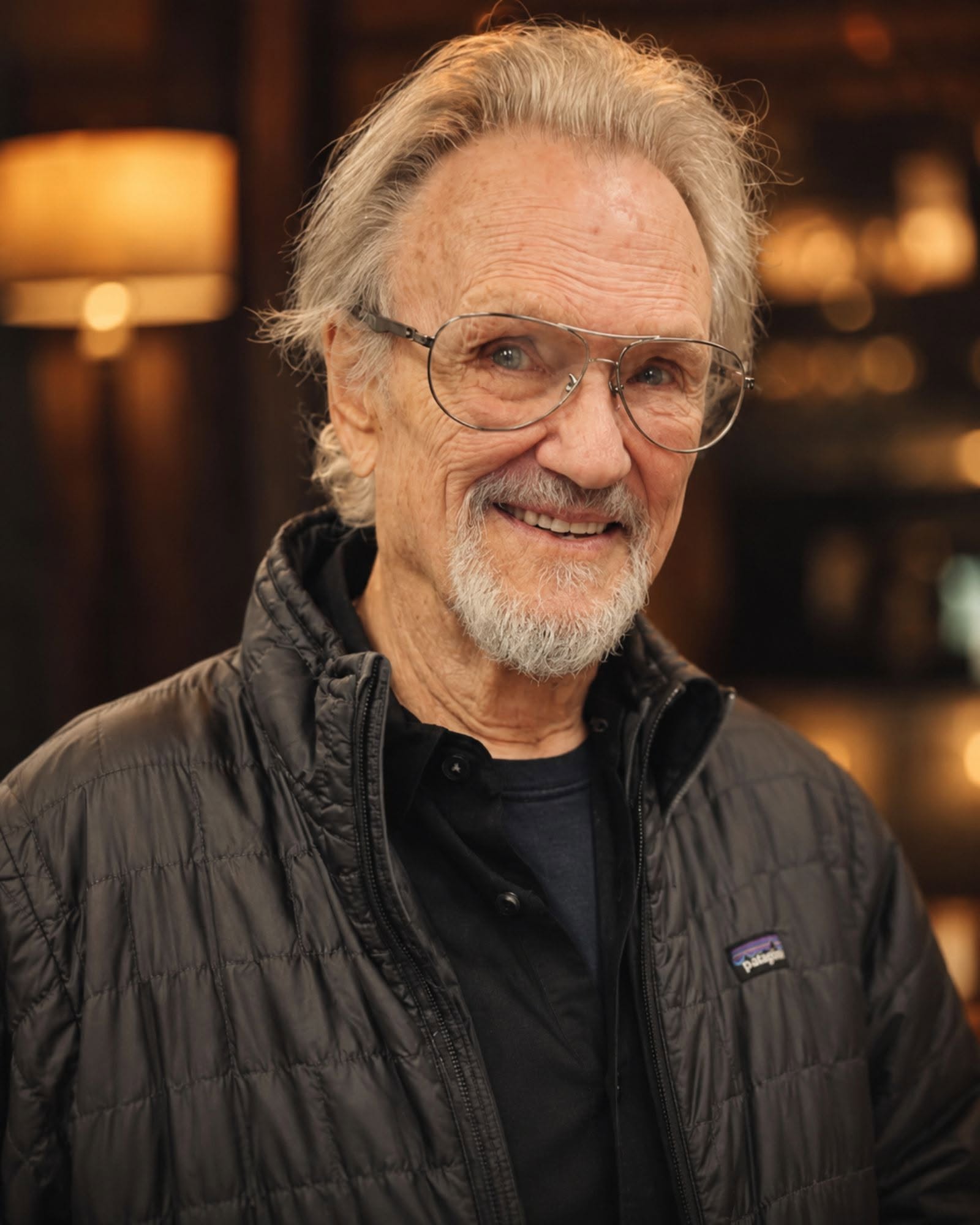
What Kris Kristofferson Left Behind Wasn’t a Career — It Was Proof That One Man Can Live Ten Lives
When Kris Kristofferson died peacefully at 88 on September 28, 2024, at his home in Maui, the news felt bigger than the loss of a singer, actor, or songwriter. It felt like the closing of a chapter written by a man who never seemed willing to live just one version of himself. He left behind eight children, three marriages, a body of work that shaped American music, and a life so full it seemed borrowed from ten different men.
He was a Golden Gloves boxer, a Rhodes Scholar at Oxford studying the poetry of William Blake, a U.S. Army Ranger, a helicopter pilot, a captain who turned down a professorship at West Point, and a man who swept floors at Columbia Records for $58 a week while chasing songs nobody had heard yet. He was also the voice behind “Me and Bobby McGee,” “Sunday Mornin’ Comin’ Down,” and “Help Me Make It Through the Night.” Later, he became one-fourth of The Highwaymen alongside Johnny Cash, Willie Nelson, and Waylon Jennings, and appeared in more than 50 films.
That is the hard part to explain about Kris Kristofferson. He did not build a career in the usual sense. He built a life that kept refusing to stay in one lane.
A Beginning Full of Expectations
Before he became a legend, Kris Kristofferson was the kind of young man people expected to follow a straight path. He came from a military family, earned the respect that came with discipline, and achieved the kind of academic success that can open every door in America and beyond. At Oxford, he studied literature and the poetry of William Blake, a world away from honky-tonks, late-night highways, and songs about heartbreak.
Then came the choice that changed everything. He was offered a future many men would have called perfect. He turned it down to pursue music.
That decision did not come with applause at first. It came with doubt, disappointment, and real personal cost. He was disowned by his family for choosing a different road. That detail matters because it reveals the true shape of his life. Kris Kristofferson did not drift into greatness. He paid for it.
The Man With the Broom and the Dream
Before the hits, before the awards, before the stage lights, Kris Kristofferson cleaned floors at Columbia Records. He was earning $58 a week while trying to get his songs heard in the building where music was made. It is one of the most human parts of his story, because it reminds us that greatness often begins in rooms where nobody is looking.
He was not too proud to work. He was not too frightened to fail. He kept moving forward with the stubborn belief that a song could change a life, maybe even his own.
“Tell the truth. Sing with passion. Work with laughter. Love with heart. ‘Cause that’s all that matters in the end.”
That line feels like the distilled version of everything Kris Kristofferson became. Honest. Unpolished. Deeply alive. He sang like a man who had lived enough to understand the cost of every word.
The Songs That Would Not Be Ignored
Then the songs arrived, and they did not arrive quietly. “Me and Bobby McGee” became an anthem of freedom and loss. “Sunday Mornin’ Comin’ Down” captured loneliness with a tenderness that felt almost unbearable. “Help Me Make It Through the Night” turned vulnerability into something timeless.
Kris Kristofferson wrote songs that seemed to know the human heart before the rest of us admitted what it was doing. His lyrics were plainspoken but never simple. They carried the dust of real roads, the ache of real regret, and the strange grace of getting through one more day.
He was not a country singer who dabbled in poetry. He was a poet who found country music and made it more honest.
A Life Bigger Than the Stage
Kris Kristofferson’s story did not stop at music. He acted in over 50 films, bringing the same weathered truth to the screen that he brought to his songs. He stood beside giants and somehow never looked small. He became part of The Highwaymen, a supergroup that felt less like a band and more like a meeting of American legends.
And still, what makes Kris Kristofferson unforgettable is not just the résumé. It is the courage behind the résumé. He was a soldier who chose songs over stars on his shoulder. A scholar who chose whiskey bars over ivory towers. A man who believed that freedom meant taking the road that scared him most.
He lived as though life was not a single assignment but a series of doors, each one worth opening.
The Lesson He Left Behind
Long after the last note of “Me and Bobby McGee” fades from the radio, Kris Kristofferson’s real lesson remains. A life fully lived, messy and brave and unafraid, is worth more than a hundred lives safely spent.
He did not leave behind a neat story. He left behind a human one. A story of risk. Of reinvention. Of talent matched by nerve. Of choosing the harder road and finding meaning there.
In the end, Kris Kristofferson proved something rare: one man really can live ten lives, and if he lives them with honesty, heart, and courage, the world will remember not just what he did, but how fully he dared to be himself.