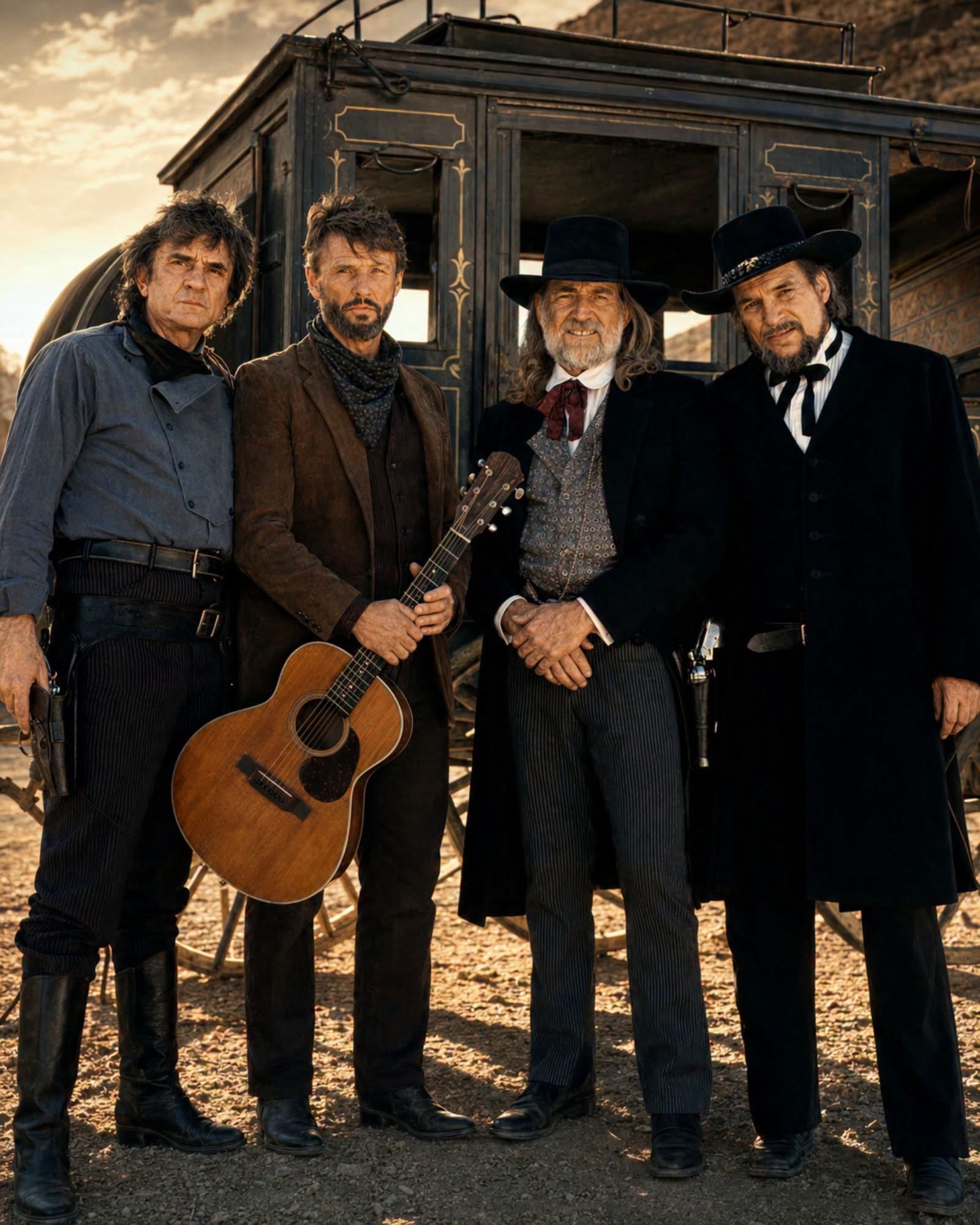
They Spent Two Days in the Studio Finding Out They Couldn’t Sing Together
In December 1984, four giants of country music walked into Chips Moman’s studio in Nashville with a simple plan and no idea how hard it would be. Johnny Cash had recently pulled Willie Nelson, Waylon Jennings, and Kris Kristofferson to Montreux, Switzerland, to film a Christmas special. At night, away from the cameras, they jammed in the hotel and started imagining a record of their own. It felt like the kind of idea that could only come from legends who had already lived a dozen musical lives.
But once the tape rolled in Nashville, the dream met reality. Two days into the sessions, the harmonies would not lock in. Johnny Cash and Willie Nelson, in particular, did not sit naturally together. The voices were powerful on their own, but in the studio they kept pushing against each other instead of blending. What sounded effortless in a hotel room had turned difficult under the bright studio lights.
Marty Stuart was there playing guitar with Johnny Cash’s band, watching the process unfold. He understood the problem quickly. The group did not need another beautiful harmony arrangement. They needed a song that gave each man his own space. So Marty Stuart suggested “Highwayman” by Jimmy Webb, and the idea made immediate sense: four verses, four singers, one verse each. No one had to crowd anyone else. No one had to disappear into a harmony line.
Jimmy Webb had already built a remarkable reputation with songs like “Wichita Lineman,” “By the Time I Get to Phoenix,” and “MacArthur Park.” “Highwayman” had a long road of its own. Webb had recorded it in London in 1977 with George Martin producing, and it had gone nowhere. Glen Campbell later recorded it and had to leave Capitol Records before it finally got released. Waylon Jennings had even heard Campbell’s version years earlier and turned it down when it was offered to him.
In the studio, Glen Campbell was present again, and he sat with the group and taught them the chords. That detail feels almost too perfect: a song rejected, rescued, and finally handed to the right voices at the right time. On December 6, 1984, the four men recorded it.
The single arrived the following May and climbed to number one on the country chart. It also gave the group their name: The Highwaymen. Jimmy Webb later won the Grammy Award for Best Country Song. What began as a problem in the studio became the defining arrangement of outlaw country.
Their greatest record happened because Johnny Cash, Willie Nelson, Waylon Jennings, and Kris Kristofferson did not try to force a harmony that was never meant to happen.
Sometimes the best answer in music is not to sing louder. Sometimes it is to listen closely, make room for each voice, and let the song decide the shape of the story.