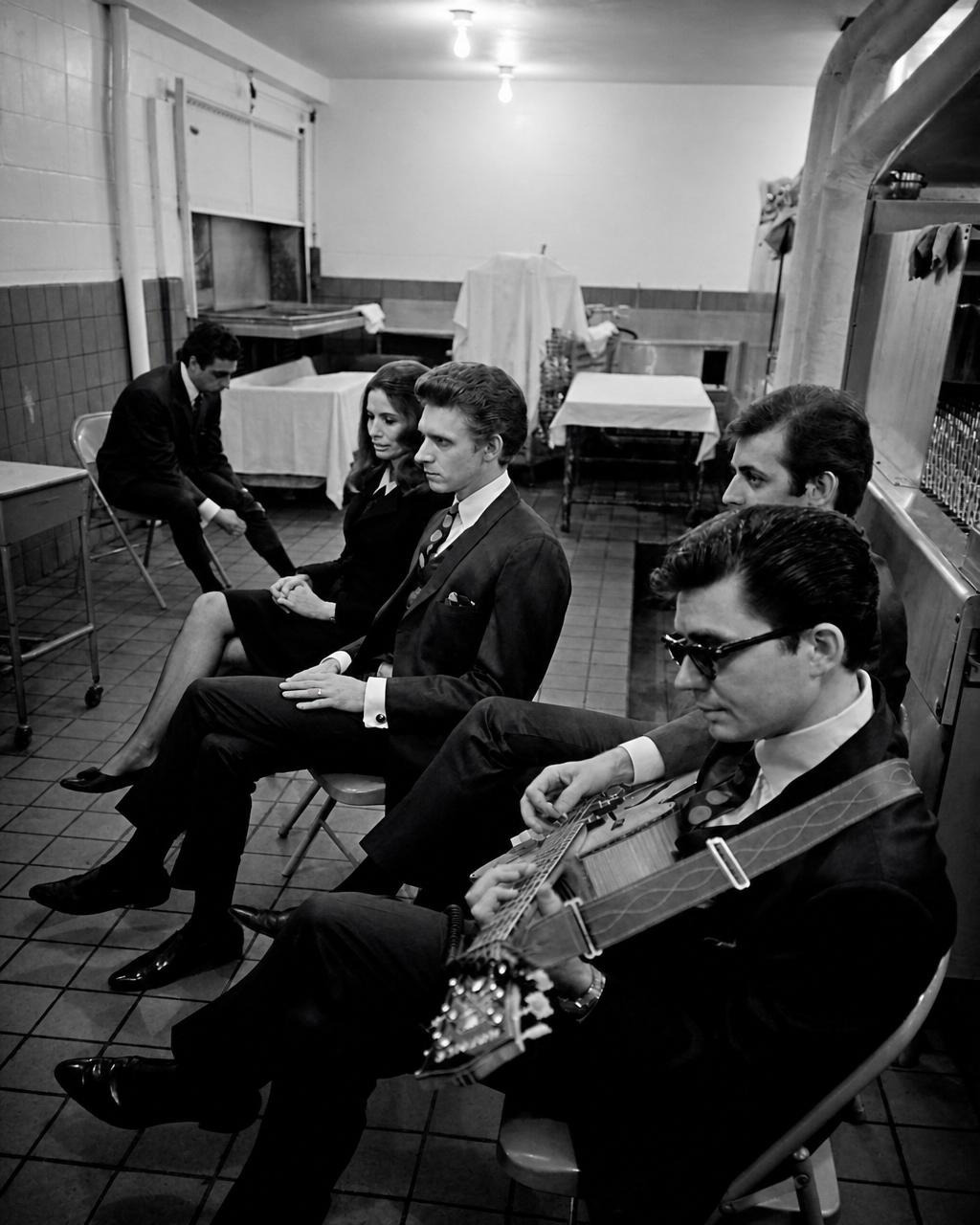
The Statler Brothers Waited for Folsom Prison in a Kitchen — Then Sang “Flowers on the Wall” to Men Who Couldn’t Walk Away from Theirs
On January 13, 1968, there was no glamorous backstage at Folsom State Prison. There were no velvet ropes, no bright dressing rooms, and no easy sense that a major moment in music history was about to happen. Instead, the Statler Brothers sat in a prison kitchen, waiting quietly, dressed in dark suits that made them look more like young men facing judgment than a gospel-country group about to perform for history.
Harold Reid was pulling up his black socks. Lew DeWitt, trying to hide his nerves, kept his dark glasses on. Don Reid was only twenty-two. Phil Balsley looked calm, but the room had that uneasy stillness that comes before something unforgettable. Photographer Jim Marshall captured the moment, and the image still feels startling: four men from Staunton, Virginia, sitting with serious faces in a prison kitchen, not yet singing, not yet knowing how deeply that day would echo through country music.
A Handshake Changed Everything
Four years earlier, Johnny Cash had heard the Statler Brothers at the Roanoke Fair and hired them with a handshake. It was one of those old-fashioned country music moments that sounds almost too simple to matter, but it changed everything. Cash did not need a long speech or a contract full of fancy promises. He heard something in their voices, in their blend, in the way they could sound polished and plain at the same time.
Their first night together, the Statler Brothers had a little idea that turned into a signature move. They imitated the trumpet parts in “Ring of Fire” with their voices. Johnny Cash laughed, and soon that playful bit became part of the show. It was proof that the Statler Brothers were not just background singers. They brought personality, timing, and a kind of musical confidence that fit perfectly beside Cash’s deep, steady voice.
By the time the Folsom Prison concert arrived, the Statler Brothers already had a Grammy-winning hit with “Flowers on the Wall.” They were no longer unknown men hoping for a break. They were building a name, one song at a time, while helping Johnny Cash create a live performance that would become legendary.
The Song Sounded Different Inside Prison Walls
Across Johnny Cash’s two performances that day, the Statler Brothers sang “This Ole House” and “Flowers on the Wall.” Outside prison, “Flowers on the Wall” had a clever, almost wry charm. It was a song about a lonely man counting flowers on wallpaper and insisting that he was doing just fine. It sounded funny, maybe a little sad, but still light enough to sing with a smile.
Inside Folsom State Prison, the joke vanished.
Those words were now landing in a place where the walls were real, the doors locked, and the passing of time meant something entirely different. The men listening knew what it meant to sit still with your own thoughts. They knew what it meant to be surrounded by concrete and routine, to watch the day repeat itself, to feel the world shrinking around you. Suddenly, “Flowers on the Wall” was not just a catchy country song. It became a song about isolation, endurance, and the strange ways people cope when they cannot walk away from the life they are living.
What had once sounded playful now felt painfully honest.
The Album Made Johnny Cash, But the Kitchen Photo Told Another Story
The live album that came out of Folsom Prison became the record that revived Johnny Cash’s career and reminded the world why his voice mattered so much. It was a defining moment, the kind that turns a concert into a legend. Yet on the original release, the Statler Brothers’ own performances were not front and center. In the credits, they were simply listed as backing vocals.
That detail never fully matched the reality of the day. The music was bigger than the credits. The atmosphere was bigger than the album notes. And the kitchen photographs remembered what the record did not: four young men standing in the middle of a prison, serious and quiet, contributing to one of the most important live recordings in country music history.
There is something deeply human about that contrast. Fame was not the point in that kitchen. Certainty was not the point. The point was showing up, doing the work, singing with conviction, and trusting that the moment would mean something even if nobody fully understood it at the time.
Four Men from Staunton Walked In as Singers
The Statler Brothers came from Staunton, Virginia, with close harmonies and a strong sense of who they were. They walked into Folsom State Prison as Johnny Cash’s singers, but they walked out carrying a piece of country music history. Not because they demanded attention, and not because they tried to steal the spotlight, but because they understood how to serve the song and the moment at the same time.
That day at Folsom was more than a concert. It was a meeting between performance and reality, between entertainment and empathy. The Statler Brothers helped make that meeting possible. Their voices, their presence, and even their quiet waiting in a prison kitchen became part of the story.
Long after the last note faded, the image remained: black socks, dark glasses, young faces, and the strange dignity of men waiting to sing in a place built for waiting. In that kitchen, the Statler Brothers did not just prepare for a show. They became part of a moment that still feels alive, still feels human, and still reminds listeners that great music can turn even the hardest room into something unforgettable.