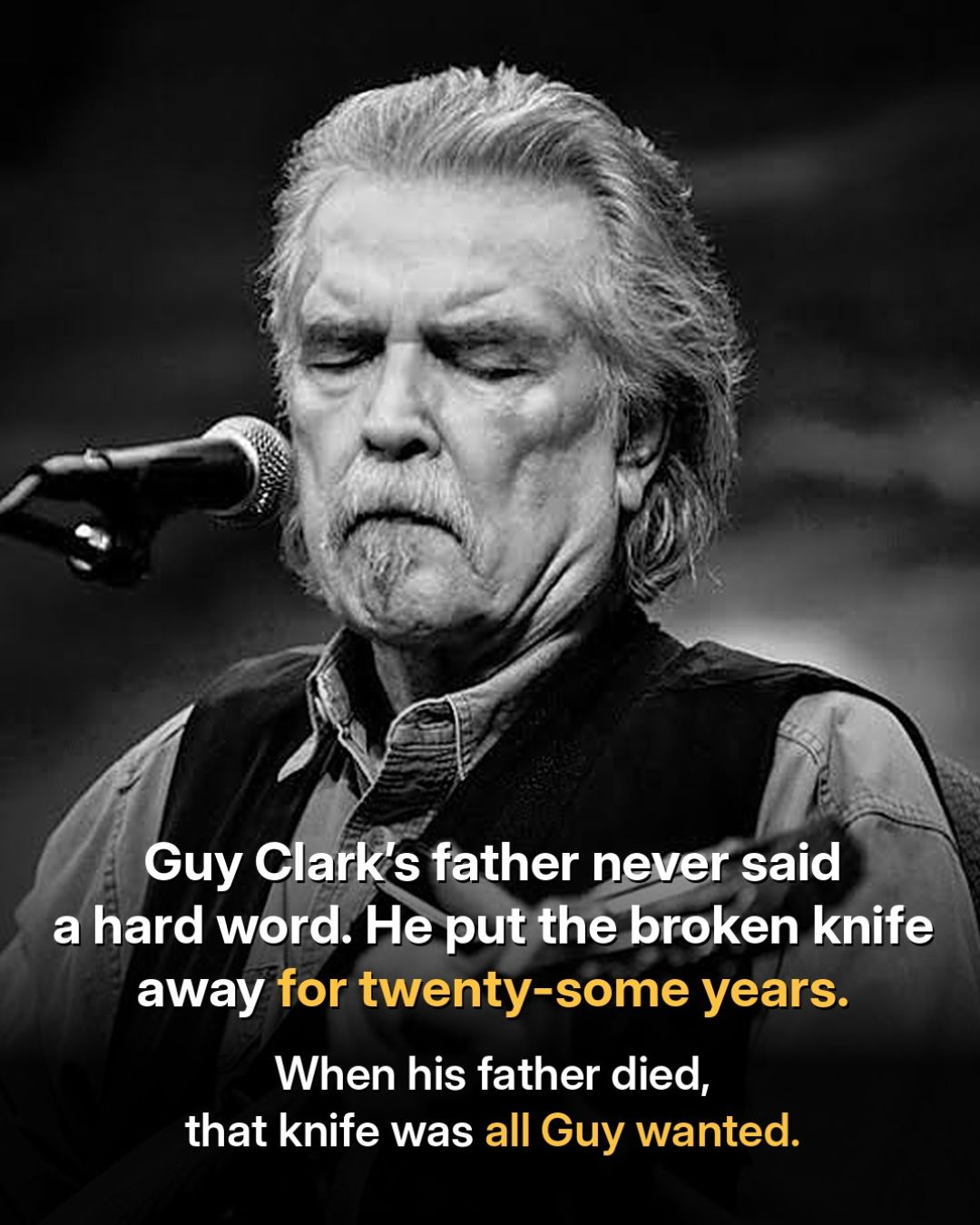
Scroll to the end of the article to hear the song.
Guy Clark called it a poem before he ever called it a song. He wrote it a couple of weeks after his father, Ellis Clark, died, and it became “The Randall Knife,” first released on his 1983 album Better Days. It is a story about one object: a knife his father carried to World War II, a knife Guy damaged as a boy, and the only thing he wanted from the house when his father was gone.
A Knife That Went to War
Ellis Clark was a lawyer. After he came home from World War II and finished law school, he moved the family to Rockport, a small town on the Texas Gulf Coast, and built his practice there. Before he left for the war, as Guy tells it in the song, Guy’s mother gave him a knife made by Randall, the Florida shop Bo Randall started in the 1930s.
Guy described his father as a good man and a lawyer by trade, and he remembered only one time his father used the blade carelessly. He tried to use it as an ordinary tool and nearly took his own thumb off. As Guy saw it, the knife was made for darker work than that.
The Jamboree, and Who Really Made the Last Throw
In the song, the story is simple. Ellis let his son take the knife on a Boy Scout jamboree. The tip snapped off while Guy was throwing it at a tree, and he kept the damage from his father for a while. In that telling, the fault is all his.
The fuller story came out much later. Biographer Tamara Saviano, author of Without Getting Killed or Caught: The Life and Music of Guy Clark, told the Houston Chronicle in 2017 that Guy often recorded conversations with friends and family. In 1981, after his father died, he taped talks with his mother and his sisters. On those tapes, the jamboree story sounds different: Guy and a friend named Victor Torres took turns throwing the knife at a tree, and it was Victor who made the last throw that snapped the tip.
When Saviano asked Guy about Victor Torres, he was surprised she even knew the name. As the Chronicle put it, he took the blame for the broken knife, both in person and in the song.
The knife did get mended. According to the Chronicle, Guy’s mother took it to a specialist in Cuero, Texas, who ground the blade down and shaped a new tip. Houston attorney Dick DeGuerin, a friend of Guy’s who later recited the song at a tribute concert, noted that the blade still sits a little short in its sheath.
Twenty-Some Years in a Bottom Drawer
Ellis Clark never said a hard word to his son about the knife. He put it away in a bottom drawer, and it stayed there for more than twenty years.
Then his father died. Guy was forty, by the song’s account. Of everything his father owned, the knife was the one thing he wanted.
A Poem That Was Never Meant to Be a Song
Guy wrote about the knife within a couple of weeks of his father’s death. Years later, he explained to Lone Star Music Magazine how it started:
It was not meant to be a song, but rather a poem, sort of a cathartic thing.
He thought of it as something for himself. When his wife, Susanna Clark, heard it and asked what he planned to do with it, he told her it was just for him. She disagreed. In her view, it belonged to everyone.
She was right. Guy half-spoke the words over fingerpicked guitar, closer to a story told at the kitchen table than a country single. He recorded it on Better Days in 1983 and again on Dublin Blues in 1995, and it became one of the songs crowds called out for most at his shows. Even so, Guy admitted he was still a little surprised that audiences would sit through something so personal.
Where the Knife Ended Up
In his later years, the knife lived in the basement workshop of Guy Clark’s Nashville home, on the workbench beside the tools he used to build guitars. Nearby were knives that fans had sent him because of the song, and a letter of thanks signed by the knife maker himself.
After Guy Clark died in May 2016, his father’s knife went to his son, Travis, its blade still a little short for its sheath.