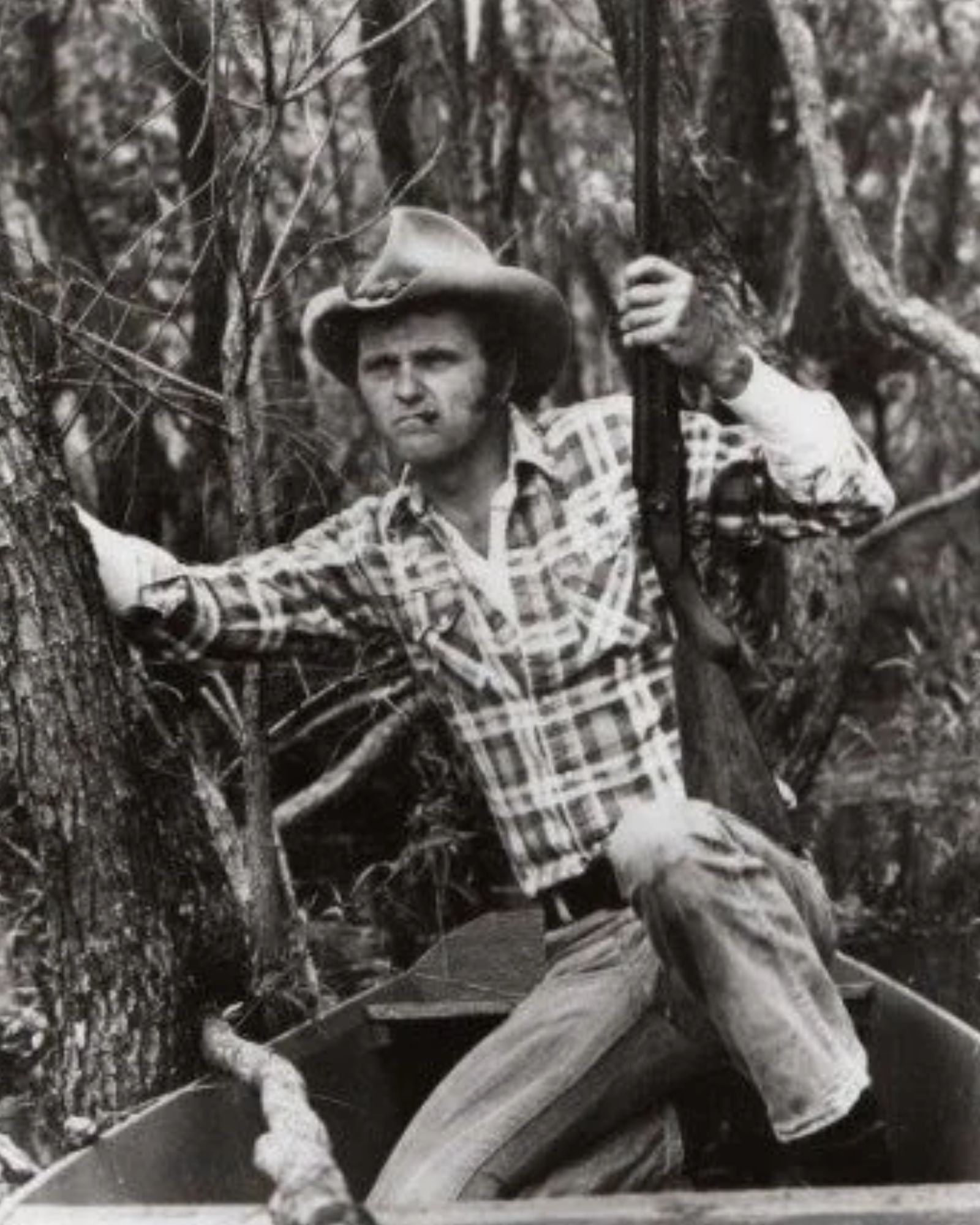
In the fall of 1970, Jerry Reed sent a one-armed Cajun alligator poacher named Amos Moses onto American radio. The song was a tall tale from the first bar to the last, and it became the biggest pop hit of Reed’s career. Yet the one line that sounded most like a joke, the warning that hunting alligators in the swamp was against the law, was simply a fact.
A Georgia picker, not a Cajun
Reed was not a man of the bayou. He was born Jerry Reed Hubbard in Atlanta on March 20, 1937. His parents separated four months later, and he and his sister spent seven years in foster homes and orphanages before he was reunited with his mother and stepfather in 1944.
He grew up around Palmetto, Fairburn and Atlanta. His stepfather bought him a seven-dollar guitar, his mother showed him three chords, and at about twelve or thirteen he sat on a porch in a cotton mill village until his thumb could keep the rhythm while his fingers played the melody. By his late teens he had a Capitol Records contract. By the late 1960s he was one of Nashville’s most sought-after session guitarists, and Elvis Presley had recorded his “Guitar Man” and “U.S. Male.”
Late in life, he summed up his method in two short sentences:
I wrote to the guitar. And I wrote to humour.
A swamp built from scratch
“Amos Moses” is built exactly that way. Over a strutting guitar figure, Reed tells of a boy raised by a man called Doc Milsap and his wife Hannah, named after a man of the cloth, and used by his own father as alligator bait. An alligator takes his left arm to the elbow, yet he still traps the biggest gators with the hand he has left. When a sheriff slips into the swamp to arrest him, the sheriff is never seen again, and the song leaves his fate to the listener.
Reed anchored the fantasy to a real map. He placed the family about 45 minutes southeast of Thibodaux, the parish seat of Lafourche Parish on Bayou Lafourche. The French name tripped up so many listeners that lyric sites still print it as “Tippitoe.”
How Reed put the song together is less certain. A widely repeated theory holds that he had two unfinished sets of lyrics and stitched them into one, with the funnier part first. It is an appealing story, but it has never been confirmed in Reed’s own words and should be treated as a theory.
The law really was after him
The legal warning in the song was accurate. According to the Louisiana Department of Wildlife and Fisheries, alligator hunting had gone largely unregulated for decades, and populations had fallen so sharply by the early 1950s that the state closed the season in 1962. From then until August 1972, alligators in Louisiana were totally protected.
The first legal hunt did not return until September 5, 1972, and only in Cameron Parish, where 59 hunters took 1,350 alligators. Lafourche Parish, home of Thibodaux, was not added until 1979, and the season did not go statewide until 1981. Any real Amos working the marshes in 1970 would have been doing exactly what the song said: breaking the law.
A lean record from Chet Atkins
Chet Atkins produced the record, with the songwriting credited under Reed’s real name, Hubbard. Instead of the strings and backing voices of the Nashville Sound, it rides on Reed’s clipped, funky guitar and a stripped-down rhythm section, a blend later filed under swamp rock. Nashville drummer Larrie Londin has been credited with the song’s lurching beat. Reed later called Londin the greatest studio drummer Nashville ever produced and said he played in his band for years.
The single was pulled from the album Georgia Sunshine, backed with “The Preacher and the Bear.” Most discographies date its release to October 19, 1970, the same day Reed’s second daughter, Lottie, was born.
Country hesitated, pop did not
The song entered the Billboard Hot 100 at No. 97 on October 31, 1970, and climbed to No. 8 in late February and early March 1971. It reached No. 2 in Canada and sold a million copies, earning a gold record. Country radio was cooler. On Billboard’s country chart it stopped at No. 16.
Reed had a national stage at exactly the right moment. In September 1970 he joined the cast of The Glen Campbell Goodtime Hour on CBS. He later recalled flying from Nashville to Los Angeles every Monday, taping on Thursday and catching the red-eye home, week after week. Within months, his follow-up “When You’re Hot, You’re Hot” went to No. 1 on the country chart and won him a Grammy.
So was there a real Amos Moses?
No real Amos Moses has ever been documented. The song is constructed as a tall tale, and the man who wrote it was a Georgia guitar picker who said he wrote to make people laugh.
The character still outgrew the record. Walter Hill’s 1981 film Southern Comfort gave the name Amos Moses to its Cajun trapper, played by Brion James. Primus, Les Claypool, Alabama 3 and the Sensational Alex Harvey Band all recorded the song, and a new generation heard it on the country station in Grand Theft Auto: San Andreas in 2004.
Reed never tired of it. In a 2005 interview, asked which three songs he would sing for the rest of his life if he could only have three, he named “Amos Moses” first, ahead of “A Thing Called Love” and “East Bound and Down.” He died in Nashville on September 1, 2008, at 71, and was inducted into the Country Music Hall of Fame in 2017.