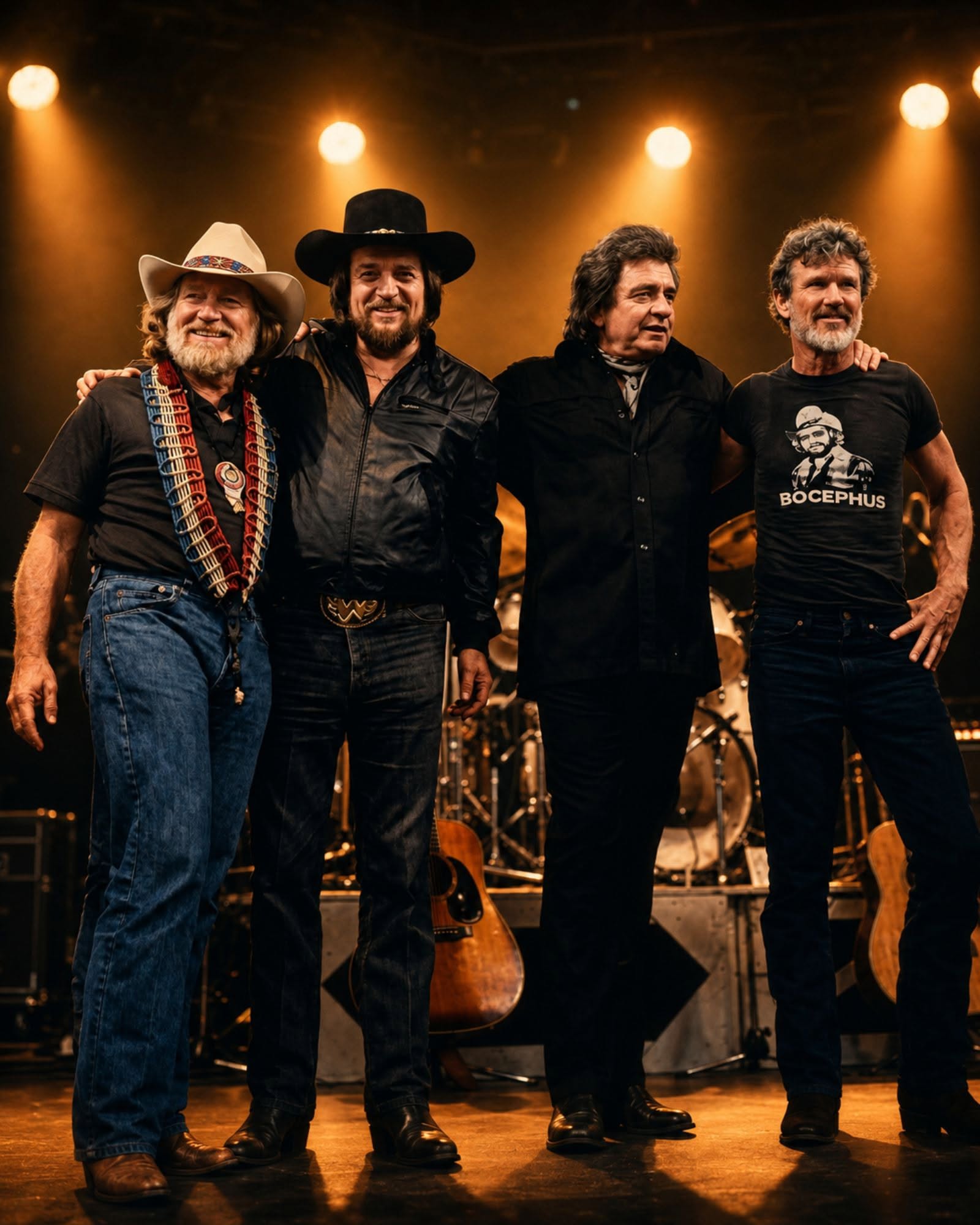
Four Men Who Didn’t Need Each Other Made Something None of Them Could Have Made Alone
By 1985, Johnny Cash, Waylon Jennings, Willie Nelson, and Kris Kristofferson had already built four separate legacies. Each man had a different kind of gravity. Johnny Cash carried darkness and compassion in the same voice. Waylon Jennings pushed back against the Nashville machine and helped define outlaw country. Willie Nelson made wandering feel like a form of wisdom. Kris Kristofferson wrote songs with the hard clarity of a poet who had lived enough to mean every line.
They did not come together because they were short on ideas. They came together because each of them had already survived enough life to recognize another survivor. The result was The Highwaymen, a country supergroup that first arrived with the album Highwayman in 1985. It should have felt crowded. Instead, it felt like four different storms moving in the same direction.
A Song That Fit Their Lives
The title track, “Highwayman,” had already existed before the group made it famous. Written by Jimmy Webb, it tells the story of one soul returning in different forms: outlaw, sailor, worker, and traveler among the stars. That idea of rebirth gave each singer room to step into the song as if it had been waiting for him.
When Johnny Cash sang, the song seemed to carry shadow and redemption at once. When Waylon Jennings sang, it sounded like defiance with a steady heartbeat. When Willie Nelson sang, it drifted like dust on a long road. When Kris Kristofferson sang, it landed with the weight of hard-won truth.
What made The Highwaymen special was not perfection. It was balance. None of them tried to dominate the others. They had all spent years being larger than the rooms they entered, and now they were willing to share the frame. That gave the music a rare kind of honesty.
Four Icons, One Identity
The Highwaymen became more than a novelty because the members were not pretending to be younger, cleaner, or simpler than they were. They were older men singing as older men, carrying memory instead of hiding it. The project worked because it felt earned. Their voices did not blend into one polished sound. They kept their edges, and those edges made the harmony stronger.
Across the years, the group became part of country music history not because it solved a problem, but because it proved something quietly powerful: collaboration can be most moving when nobody in the room needs saving. Sometimes the real miracle is that four legends, each already complete in his own way, can still make room for one another.
What They Left Behind
The Highwaymen sounded like men who had already lived through reinvention and disappointment, applause and exhaustion, reinvention again and again. That is why the songs still matter. They do not feel manufactured. They feel like testimony.
Some groups are built to chase success. The Highwaymen felt like a meeting of souls who understood the road too well to romanticize it. Four men who did not need each other still found a way to make something larger than any one of them. That is the kind of unity audiences do not forget.