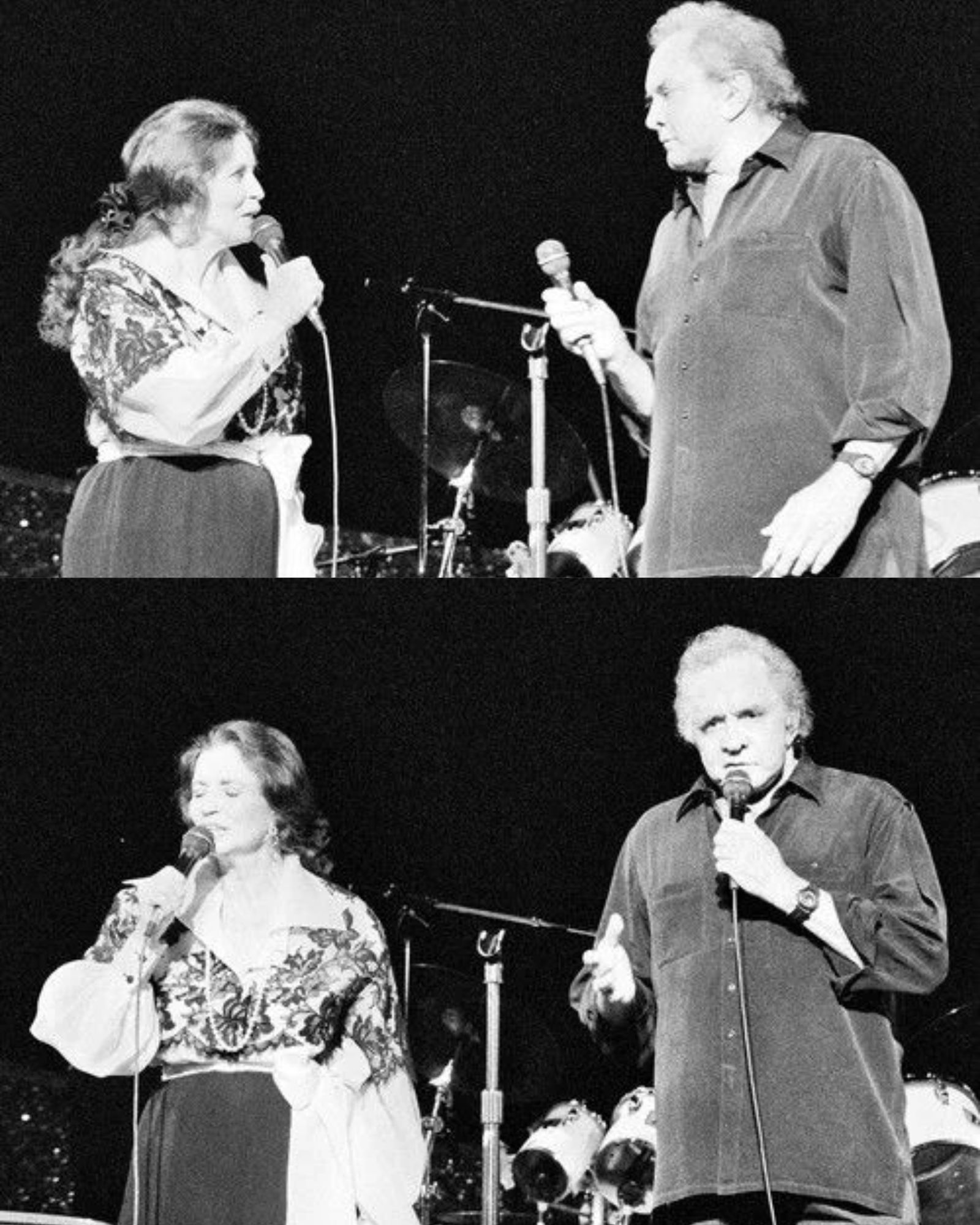
It was February 24, 1969, and the dining hall at San Quentin State Prison was packed with inmates who had waited a long time for this day. Johnny Cash stood on the small stage with his guitar, a television crew moving around him, and hundreds of men watching every move he made. Then, early in the show, Johnny Cash stopped, looked toward the side of the stage, and said the words that would lead to one of the sweetest moments on the whole record: “Come here, June.”
That moment became “Darlin’ Companion,” a love song that Johnny Cash and June Carter sang together in one of the toughest rooms in America.
A Difficult Day on Stage
Johnny Cash was not having an easy time that afternoon. A crew from Granada Television in Britain was filming the concert, and on the full recording you can hear him grumbling about being told what to sing and where to stand. Years later he wrote that the cameras kept blocking his view of the very men he had come to sing for.
He sounded tired, and he knew it. But instead of letting it ruin the show, he turned it into a joke for the crowd:
“Ol’ Johnny does best under pressure.” — Johnny Cash
And he proved it. He told the inmates that later in the show he would play a brand-new song he had written just the day before, called “San Quentin.” First, though, he wanted his wife beside him.
A Song That Wasn’t His
The song Johnny Cash chose was not one of his own. It was written by John Sebastian of the Lovin’ Spoonful, and the band had released it in 1966 as a light, easygoing folk-pop tune. In 1967 it ended up on the B-side of the Lovin’ Spoonful single “Darling Be Home Soon,” where most listeners probably never paid it much attention.
But Johnny Cash and June Carter heard something in it. The song is a simple promise from one person to another: understand me, let me take care of you, and I will stand by you no matter what. For a couple who had married only the year before, after many years of touring together, those words did not need any extra explanation.
“Come Here, June”
June Carter walked out to join him. Johnny Cash called for Carl Perkins to come help on guitar, and he introduced the song as their own version of a John Sebastian tune. Then the two of them started to sing.
June Carter sang harmony and traded lines with her husband on the chorus. The rhythm had an easy swing, and for a few minutes the room felt less like a prison and more like a Saturday night at the Grand Ole Opry. The men in the hall cheered them on, and the couple played to the crowd and to each other.
On the original album, the track runs more than six minutes, much longer than the Lovin’ Spoonful version. That is because the microphones caught everything: the introduction, the stage talk, the laughter and the applause. It is not a polished studio duet. It is a real moment between Johnny Cash and June Carter, captured exactly as it happened.
A Record That Made History
Columbia Records released Johnny Cash at San Quentin in June 1969. The album went to No. 1 on both the Billboard pop and country album charts and later went triple platinum in the United States. The same concert gave the world the first live performance of “A Boy Named Sue,” and the inmates loved “San Quentin” so much that Johnny Cash played it twice.
Among those big moments, “Darlin’ Companion” was the gentle one, the song where the toughest man in country music simply asked his wife to sing with him.
Looking Back
When the complete concert was released in 2000, both Johnny Cash and June Carter Cash wrote liner notes for it, more than thirty years after that day at San Quentin. Today, when fans want to hear what Johnny and June sounded like together on a live stage, this is one of the first recordings they reach for.