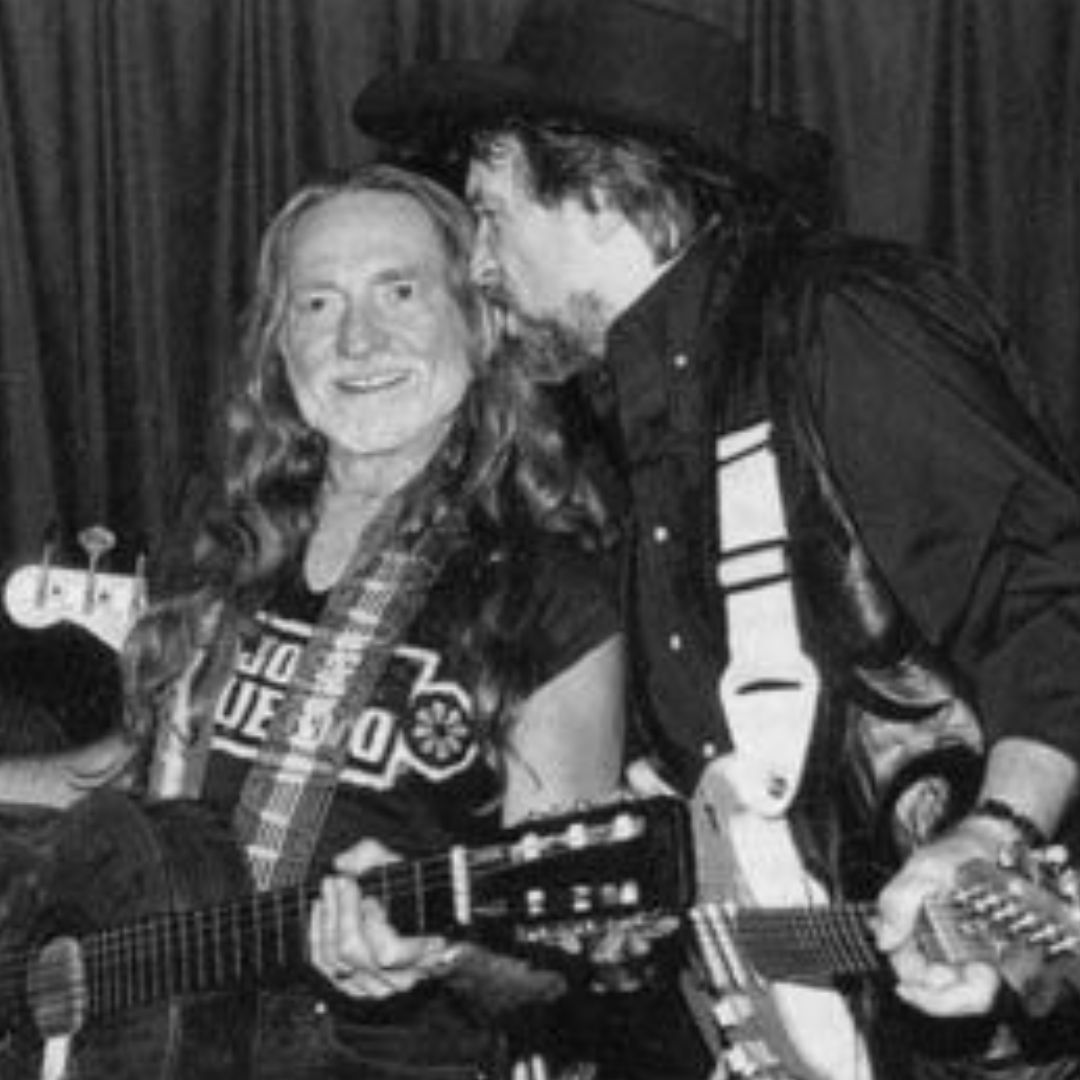
Few country songs have done more for a town than “Luckenbach, Texas (Back to the Basics of Love).” It turned a nearly forgotten spot in the Texas Hill Country into a place people drive hundreds of miles to see. It gave Waylon Jennings the biggest country hit of his career.
And for almost two decades, Waylon Jennings refused to go there.
A Town That Was Barely a Town
Luckenbach was founded in 1849, and by the early 1970s it was close to becoming a ghost town. In 1971 a Texas humorist named Hondo Crouch bought the place. There was not much to buy: an old general store, a dance hall and a few buildings. Crouch filled the walls with old signs and license plates and gave the town a motto, “Everybody’s Somebody in Luckenbach.”
A few years later, Jerry Jeff Walker recorded his album ¡Viva Terlingua! in the Luckenbach dance hall. A small crowd of Texas music fans knew the name. The rest of America had never heard of it.
Written by Two Men Who Had Never Been There
The song was written by Chips Moman and Bobby Emmons, two Nashville music men. Neither of them had been to Luckenbach. They brought the song to Waylon Jennings because his name was in it, and Moman produced the recording.
Waylon said it plainly in his autobiography: “I’ve never been to Luckenbach.” He added that Moman and Emmons had not been there either.
He knew the song was a hit the first time he heard it. He also did not like it. He wrote that its laid-back rhythm kept making him want to rush. His son, Shooter Jennings, later explained another reason: his father did not like singing his own name in a song.
The Drummer’s Theory
Richie Albright played drums for Waylon Jennings for decades. He had his own idea about why Waylon never warmed up to the record, and it had to do with Willie Nelson.
On the finished version, Willie sang the last verse. And according to Albright, the song itself grew out of a sore spot between the two friends.
“He and Willie used to get at each other every now and then.”
Albright remembered Waylon complaining about one of Willie’s big concerts, a show where the money disappeared and nobody got paid. Albright said that grumbling is where Chips Moman and Bobby Emmons got the idea for the song. So a tune that sounds like a sweet invitation to slow down and visit Texas may have started with Waylon fussing about a payday that never came, and Willie got the last word on the record.
Albright also recalled that years later, during another session, Waylon asked to be reminded, the next time he picked singles, that he would have to sing this one every night for the rest of his life.
Six Weeks at No. 1
RCA released “Luckenbach, Texas” on April 11, 1977, as the lead single from Ol’ Waylon. On May 21 it reached No. 1 on Billboard’s Hot Country Singles chart, and it stayed there for six straight weeks. It became Waylon’s first solo crossover hit, reaching No. 25 on the pop chart, and it cracked the adult contemporary chart too.
No country single Waylon Jennings ever made went higher or stayed longer. The song helped make Ol’ Waylon the first album by a solo country artist to be certified platinum.
The Tourists Came. Waylon Didn’t.
After the song hit, people started driving out to Luckenbach to find the place Waylon was singing about. They wanted to see the town of Waylon, Willie and the boys. So many visitors pulled down the city-limits signs as souvenirs that the town kept losing them.
Waylon Jennings still stayed away. Onstage, he was known to change the words of the song to say he was never going and was tired of singing about the place.
Willie Finally Got Him There
In 1995, Willie Nelson moved his famous Fourth of July Picnic to Luckenbach. The next summer, in 1996, Waylon Jennings was on the bill. Nineteen years after the song came out, he finally played the town he had made famous.
According to the Austin Chronicle, he still did not look happy singing “Luckenbach, Texas.” Luckenbach’s mayor had already offered her own explanation for why it had taken him so long: he probably could not find it.
Waylon Jennings died in 2002. Luckenbach is still there, still selling souvenirs, still hosting music, and still drawing visitors who come because of a song its singer never wanted to sing.
Have you ever made the drive to Luckenbach? What song was playing when you got there?