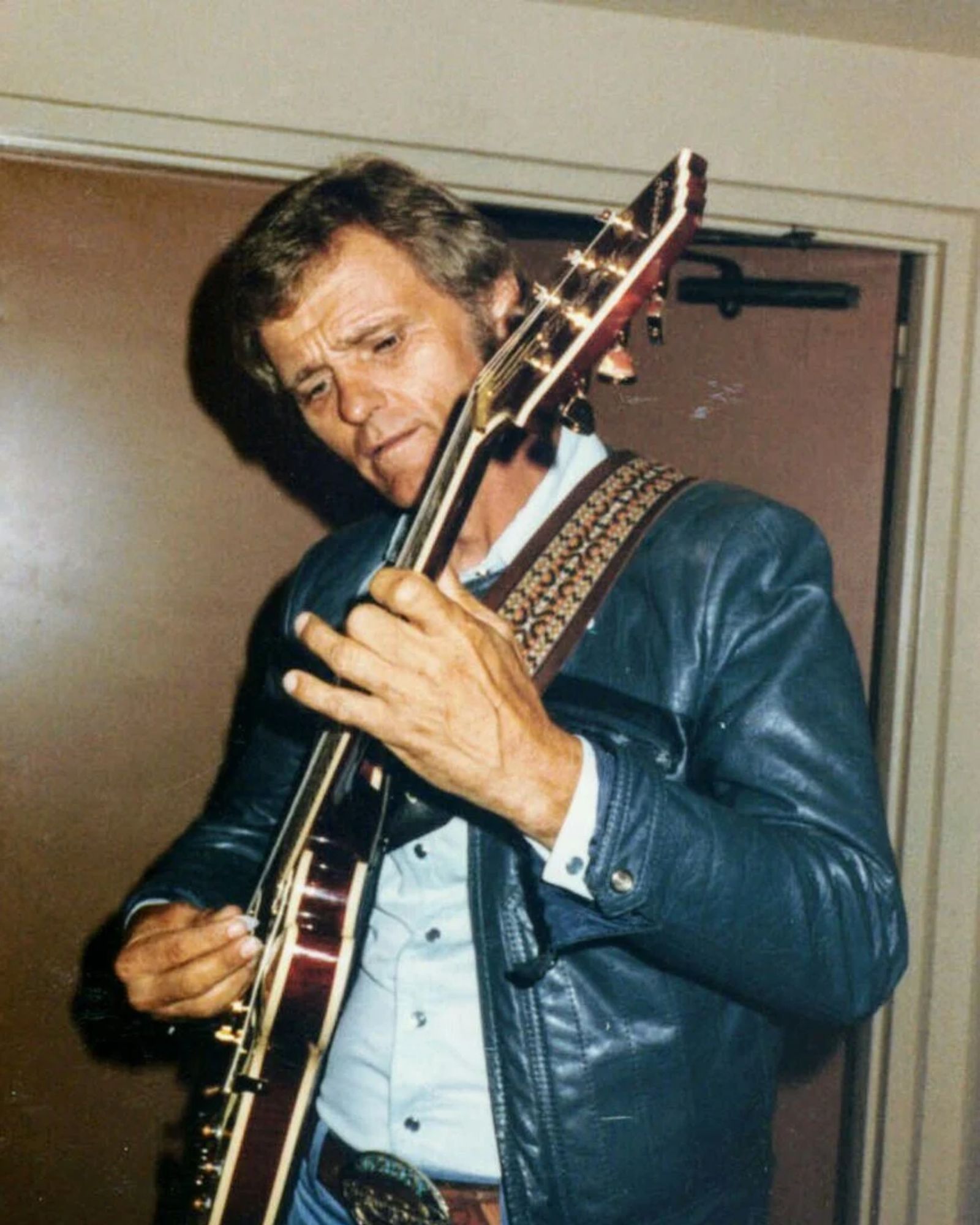
Jerry Reed spent a lifetime making people laugh, sing along, and wonder how one man could make a guitar sound like three instruments at once. But when the time came to say goodbye, Jerry Reed wanted none of the attention that had followed such a remarkable career.
The family honored that wish. The musicians who admired Jerry Reed found another way to remember the man behind the music.
A Quiet Goodbye for the Man Called the Snowman
Jerry Reed died at home in Brentwood, Tennessee, at the beginning of September 2008. The Country Music Hall of Fame records September 1 as the date of death. Jerry Reed was 71.
Millions remembered Jerry Reed as the wisecracking truck driver known as the Snowman in Smokey and the Bandit, starring alongside Burt Reynolds. Others remembered the unmistakable voice behind “Amos Moses,” “When You’re Hot, You’re Hot,” and “East Bound and Down.”
But Jerry Reed had requested a quick, private funeral, without a large public production. Jerry Reed was buried in Nashville on Tuesday afternoon, September 2.
There was no need to turn the farewell into another performance. The family respected the decision.
For Nashville’s guitar community, however, Jerry Reed’s passing left something unfinished.
The Night Nashville’s Guitar Players Came Together
On September 15, 2008, musicians gathered at Douglas Corner in Nashville for a free concert called A Celebration of the Music of Jerry Reed.
Guitarist Richard Smith organized the tribute after hearing how many fellow musicians wanted an opportunity to honor Jerry Reed through music.
Among the performers were Brent Mason, one of Nashville’s most respected session guitarists, and Thom Bresh, son of legendary guitarist Merle Travis.
There was also a deeply personal family connection. Jerry Reed’s grandson, drummer Jerry Roe, was included in the evening’s lineup.
The gathering reflected a side of Jerry Reed that movie audiences did not always recognize. Behind the jokes and memorable characters stood a musician whose playing had challenged and inspired some of the finest guitarists in country music.
What Made Jerry Reed’s Guitar Playing So Different?
Richard Smith offered an explanation of the distinctive musical language Jerry Reed had developed.
Jerry Reed combined country guitar picking with rhythmic ideas inspired by Ray Charles’s blues piano playing and the rolling banjo technique associated with Earl Scruggs.
Those influences produced a sound that was difficult to classify. Richard Smith described the result simply as “Jerry Reed Style.”
Jerry Reed’s famous claw-style technique allowed the bass notes, rhythm, and melody to move independently. Instrumentals such as “The Claw” demonstrated an approach that other accomplished musicians spent years studying.
Even Chet Atkins, already one of the most influential guitarists in Nashville, recognized something extraordinary in Jerry Reed’s playing.
Chet Atkins encouraged Jerry Reed’s individuality at RCA Records. Their musical partnership produced two guitar duet albums, including Me and Jerry, which earned a Grammy Award.
Jerry Reed was not simply following the Nashville guitar tradition. Jerry Reed was helping change it.
Why Elvis Presley Needed Jerry Reed
One of the clearest examples came in 1967, when Elvis Presley recorded Jerry Reed’s composition “Guitar Man.”
Elvis Presley wanted the unusual guitar sound heard on Jerry Reed’s original recording. Reproducing that distinctive picking style was not a straightforward assignment for other session musicians.
Jerry Reed was brought into the recording session to play the guitar part.
Jerry Reed also played lead guitar on Elvis Presley’s recording of “U.S. Male.”
For fans who primarily knew Jerry Reed through comedy and film, those recordings reveal why professional guitarists held Jerry Reed in such high regard.
The Conversation Near the End
During Jerry Reed’s final months, music remained deeply important, although declining health had made playing guitar increasingly difficult.
In a remembrance published shortly after Jerry Reed’s death, Nashville journalist Peter Cooper described visits from old friends, including Bobby Bare.
Those visits included conversation, memories, stories, and laughter.
During an August conversation, Jerry Reed told Bobby Bare that everything Jerry Reed had ever dreamed of in life had come true.
It was a remarkable reflection from someone whose childhood had included years in foster homes and orphanages, and whose career eventually stretched from Nashville recording studios to Hollywood movies.
A Legacy That Could Still Be Heard
Jerry Reed would be inducted into the Country Music Hall of Fame in 2017, nine years after the Nashville farewell.
But the respect of fellow musicians had been evident long before that recognition.
The gathering at Douglas Corner was more than a tribute to a successful singer, songwriter, or movie star. It celebrated a musician whose unusual guitar style had become part of Nashville’s musical language.
Jerry Reed had wanted a private funeral, and that wish was honored.
Two weeks later, the guitar players came together because Jerry Reed had given them something worth carrying forward.
The Snowman was gone. The music was not.