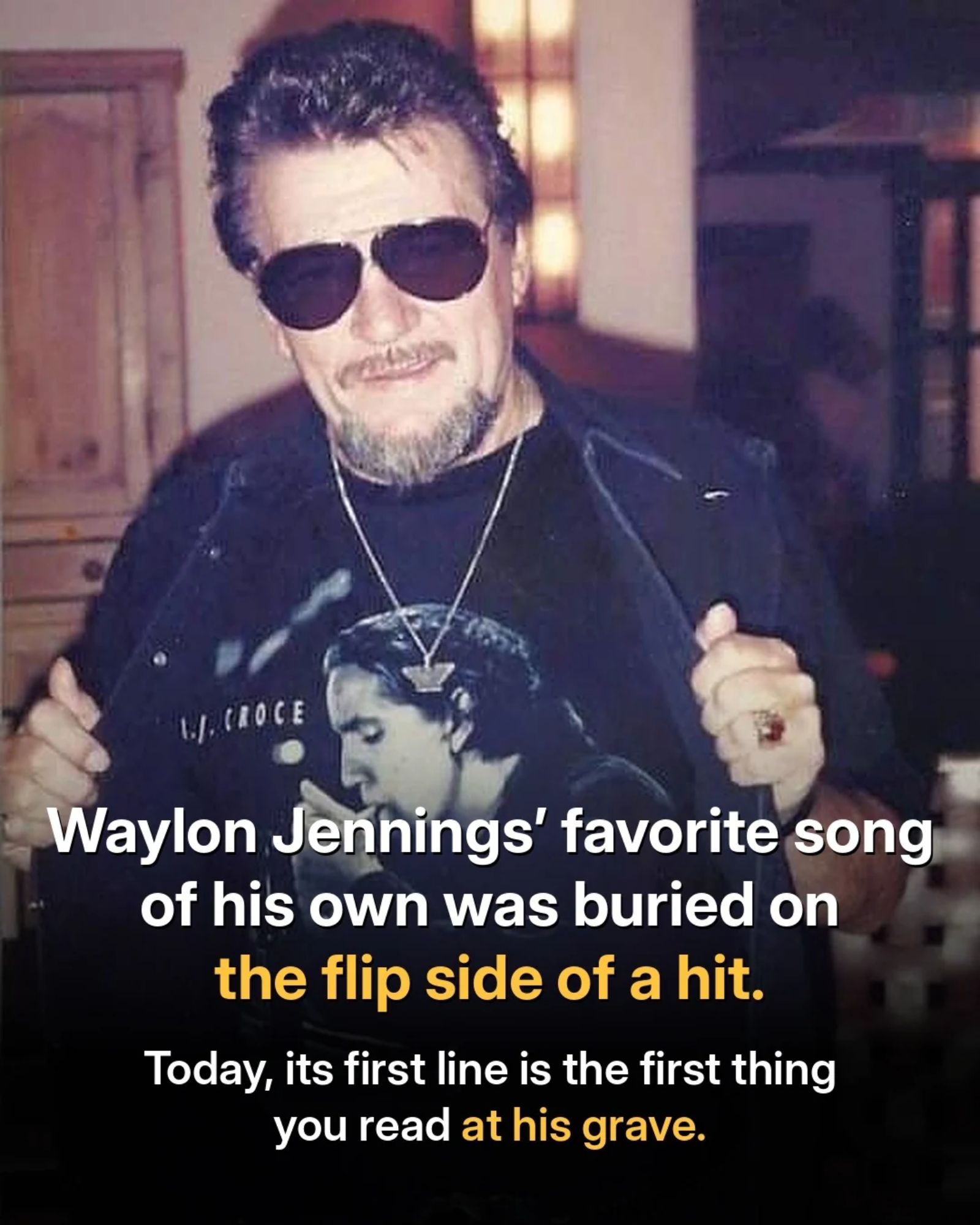
Scroll to the end of the article to hear the song.
For a whole year, fans came to the City of Mesa Cemetery in Arizona looking for Waylon Jennings and could not find him.
The cemetery is huge, a grid of numbered streets and lettered cross streets that runs on for blocks. Somewhere on that grass lay one of the men who changed country music forever. His grave had no headstone, no name, and no sign that the outlaw who sang “Luckenbach, Texas” and “Good Hearted Woman” was resting there. Some visitors drove in from far away and left without ever finding him.
A Quiet Goodbye
Waylon Jennings died at his home in Chandler, Arizona, on February 13, 2002. He was 64. Two days later his family buried him in a private service. According to his longtime publicist, Jessi Colter, his wife of more than thirty years, said the service was beautiful and was just the way Waylon would have wanted it.
Nashville gave him a louder farewell. On March 23, 2002, friends, family and fans filled the Ryman Auditorium for a celebration of his life. Kris Kristofferson, Travis Tritt, Charley Pride and his son Shooter Jennings all honored him with stories and songs.
Back in Mesa, the grass over his grave stayed unmarked.
The Stone Finally Arrives
In February 2003, almost exactly a year after he died, a black granite marker was finally set in place. It shows his face, his famous flying “W,” and two inscriptions.
One side honors the family man, calling him a loving son, husband, father and grandfather. The other side describes the man the world knew, and ends by calling him
“a revolutionary in country music, beloved by the world.”
Before those words, though, comes a line that most visitors read without realizing where it came from. It describes Waylon Jennings as a wandering dreamer, a man who made rhymes and sang songs. It reads like something a poet might have written about him.
But nobody wrote it about him. He wrote it himself, twenty-six years earlier.
The Song on the Other Side of the Record
In 1977, Waylon Jennings released Ol’ Waylon, which became the top country album of the year. Its big single was “Luckenbach, Texas (Back to the Basics of Love),” a song that played everywhere and became one of the biggest hits of his career.
Most people never flipped that record over. On the B-side was a quiet song Waylon Jennings had written himself, called “Belle of the Ball.”
It was never released as a single and never had its own run up the charts. Yet Waylon Jennings once told Jessi Colter that it was his favorite song he had ever written. Years later, Jessi Colter called it “his leaving song.”
The story in the song is simple. A restless drifter who sings to no one and belongs nowhere meets a beautiful woman that every man in the room wants. She does not truly love any of them. He sees her faults clearly and loves her anyway. Then, at the end of a night he was never invited to, he leaves and takes her with him.
Shooter Jennings has said he always heard the song as a picture of the music business itself: a glittering crowd that all looks the same, and one outsider who does things his own way. For a man whose fight with Nashville’s rules made him an outlaw, the comparison fits.
A Son’s Choice
When it came time to decide what should be carved on his father’s grave, Shooter Jennings went back to that B-side. He chose its first line because he felt it was the way his father had described himself in his own words. He also said the song had always been one of his own favorites, beautiful in both its melody and its lyrics.
So the opening line of a song almost nobody turned the record over to hear became the first thing everyone reads at Waylon Jennings’ grave.
One Last Time
The story did not end there. Waylon Jennings recorded the song again near the end of his life, in sessions with his longtime steel guitar player and friend Robby Turner. Robby Turner kept those recordings for years, then finished them with musicians from Waylon’s old band. They were released in 2012 as Goin’ Down Rockin’: The Last Recordings, with “Belle of the Ball” among them.
Robby Turner later admitted that while he recorded his steel guitar parts, just hearing Waylon Jennings play the closing notes of that song was enough to bring him to tears.
The Song That Waited Its Turn
Waylon Jennings had sixteen number one country singles. He recorded with Willie Nelson, Johnny Cash and Kris Kristofferson, and helped launch a movement that changed country music.
Yet the song he loved most was the one hiding on the back of a hit. It waited quietly for twenty-six years. Now it is the first thing you read when you finally find his name in the grass in Mesa.
Some songs are written for the radio. Some are written for the end of the story.