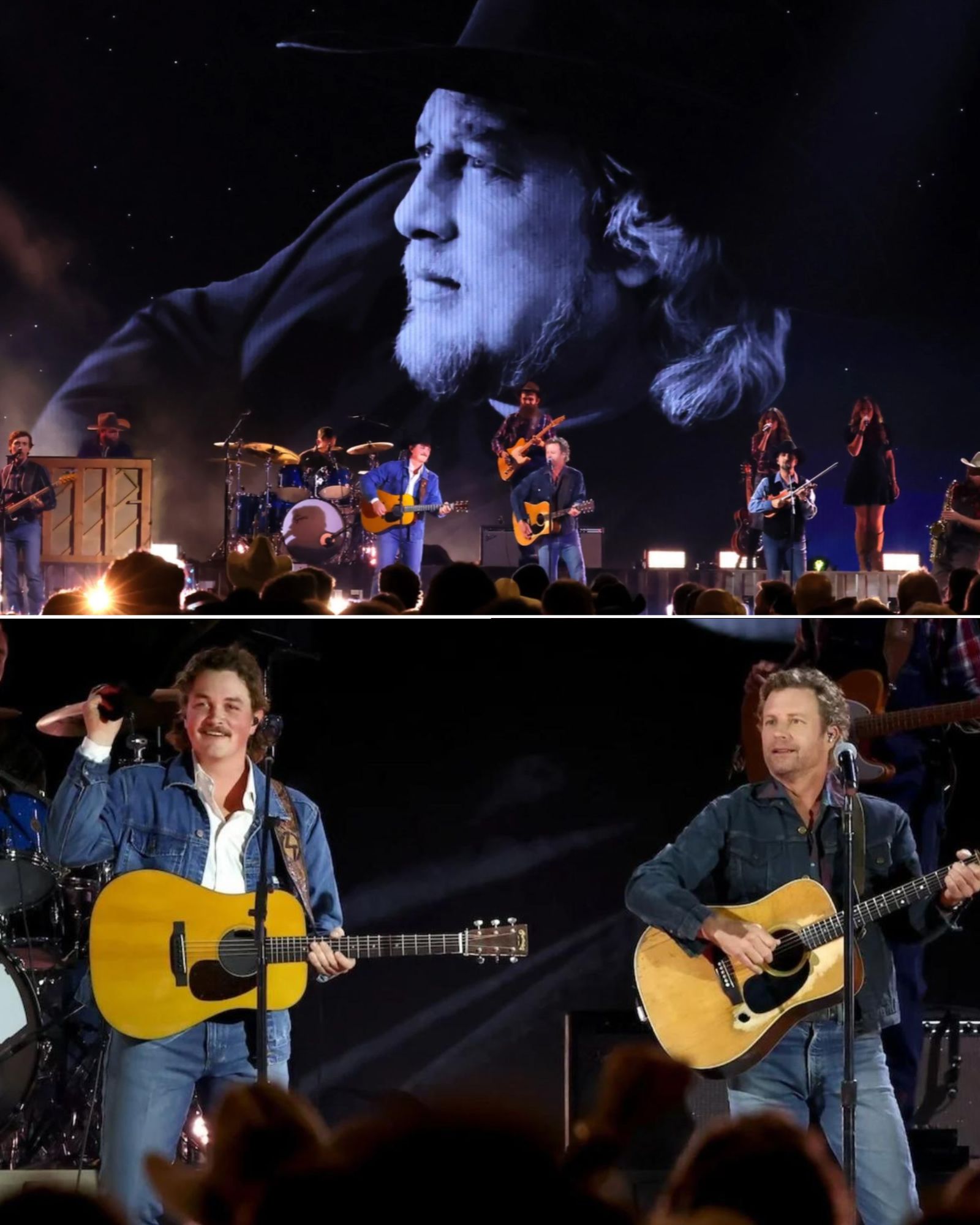
Scroll to the end of the article to hear the song.
On November 18, at the 60th Annual CMA Awards, Zach Top finished the first performance of his brand-new song “Moonshine” and did not leave the stage. The band slid straight into “Swingin’,” the John Anderson hit that won Single of the Year at the CMA Awards in 1983. A few bars in, Dierks Bentley walked out as a surprise guest. It was the show’s tribute to Anderson, who had died four weeks earlier, on October 21, at 71.
The choice of who would sing it carried its own quiet echo. Top won New Artist of the Year at the 2025 CMA Awards. In 1983, that same award was called the Horizon Award, and John Anderson won it on the same night “Swingin'” was named Single of the Year.
The Night “Swingin'” Won
John Anderson wrote “Swingin'” with his longtime writing partner Lionel Delmore, the son of Alton Delmore of the Delmore Brothers. Warner Bros. sent it out as a single from the Wild & Blue album around the turn of 1983, and by late March it had reached No. 1 on Billboard’s country chart. It also crossed over to the Billboard Hot 100 and was certified Gold.
That fall, Anderson collected both the Horizon Award and Single of the Year. In those years the CMA Awards were held at the Grand Ole Opry House, and John Anderson knew that building from a different angle. When he arrived in Nashville from Apopka, Florida, as a teenager in 1971, one of his day jobs was construction work on the new Opry House, including its roof. A decade later he was standing on its stage holding two trophies.
How the Tribute Unfolded
Zach Top was already on the performer list, so when he wrapped “Moonshine,” viewers assumed his moment was over. Instead he moved into “Swingin'” with a full band and a horn section, and Dierks Bentley joined him. According to Taste of Country, the two briefly broke into a bit of dance choreography before trading verses. A portrait of John Anderson appeared on the screen behind the stage, and cameras caught Darius Rucker and Lady A dancing along in the crowd.
Rolling Stone described it as a boisterous rendition of the song, which fits. “Swingin'” was never a slow, mournful number, and the tribute did not try to turn it into one.
Why Dierks Bentley Was Up There
Bentley’s connection to John Anderson was recent and personal. In 2025 he released the album Broken Branches, and its title track featured Anderson alongside Riley Green. Bentley said Anderson was the first person who came to mind when he wanted to add one more voice to the song.
He’s the black sheep of the family. He is the original broken branch.
That is how Bentley put it in 2025. Longtime fans will remember that “Black Sheep” was also one of Anderson’s No. 1 hits. Bentley told People that Anderson “still drives himself in an RV from gig to gig.” And in an interview with Billboard, cited by Rolling Stone, Bentley recalled that Anderson simply “came in the studio by himself.”
Zach Top Had Already Sung It Once
The CMA stage was not the first time Zach Top reached for “Swingin'” after Anderson’s death. On Thursday night, October 22, the Red Clay Strays headlined Nashville’s Bridgestone Arena, and early in their set they brought Top out for a cover of the song with frontman Brandon Coleman. Anderson had died late the night before.
Eight days later, when Top closed his own tour with his first headline show at the same arena, he also covered Anderson’s “Seminole Wind.”
John Anderson’s Last Weeks
Only days before his death, John Anderson attended the latest Country Music Hall of Fame induction ceremony, where he himself had been inducted in 2024. Tim McGraw, one of the new inductees, later wrote that Anderson was “in such good spirits” that night and that they had talked, laughed and sang his songs together.
Anderson’s family announced his death on his official social media pages and did not release a cause. He left behind five No. 1 country hits, including “Wild and Blue,” “Black Sheep,” “Straight Tequila Night,” “Money in the Bank” and “Swingin’.”
On November 18, “Swingin'” was back on the CMA stage, sung by last year’s winner of the award John Anderson took home in 1983, with the man who once called him the original broken branch singing the other half.