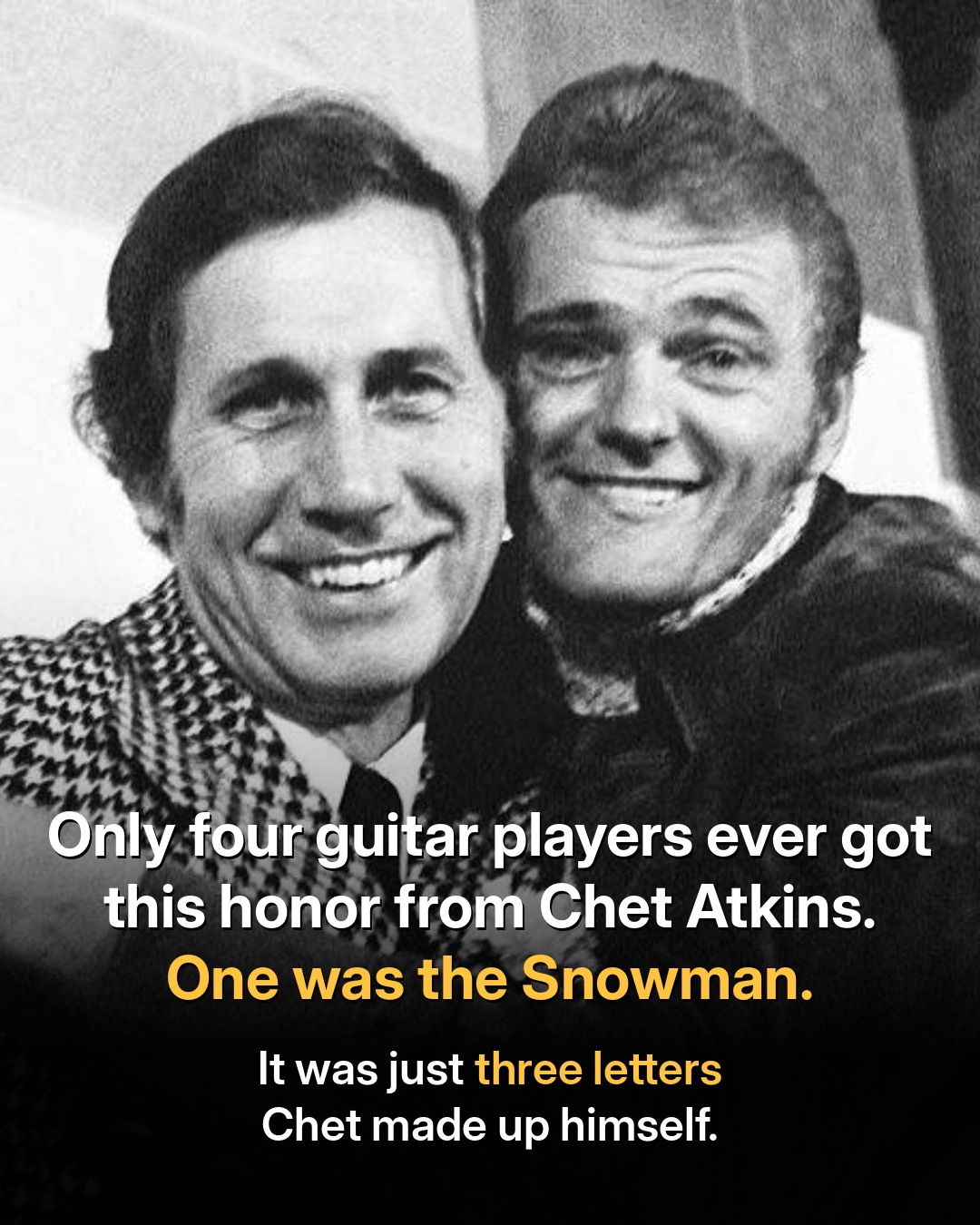
Most country fans know Jerry Reed as the grinning truck driver from Smokey and the Bandit, the guy who sang “East Bound and Down” and made it look like a good time. But among guitar players, Jerry Reed carried a different kind of credential. It wasn’t a trophy or a gold record. It was three small letters given to him by Chet Atkins: C.G.P.
Only five people ever held that title while Chet Atkins was alive, and one of them was Chet himself.
A Degree No School Ever Offered
C.G.P. stands for Certified Guitar Player. No university handed it out, and no board or committee voted on it. Chet Atkins made it up himself.
He signed his own name with it, the way a doctor or a lawyer adds letters after a name. He even put it on a record cover. His 1983 album came out as Work It Out with Chet Atkins, C.G.P. It was half a joke and half a statement. Chet Atkins had built the Nashville Sound, produced records for some of the biggest stars in the business, and influenced generations of fingerpickers. If anybody had the standing to certify a guitar player, it was him.
The stories about where the title came from don’t fully agree. Steve Wariner, speaking at the Country Music Hall of Fame, explained that Chet Atkins cleverly invented and self-awarded it early in his career to help land work. Other accounts place it later in his life. Either way, the honor became far more meaningful once Chet Atkins started giving it to other people.
The Short List
In his lifetime, Chet Atkins gave the C.G.P. title to just four other guitarists:
Tommy Emmanuel, the Australian fingerstyle virtuoso who taught himself by slowing records down to learn what Chet Atkins and Jerry Reed were playing.
John Knowles, a gifted player and educator.
Steve Wariner, the country hitmaker and longtime friend of Chet Atkins.
Jerry Reed, the wildcard of the bunch.
That’s a remarkably short list. Countless great pickers came through Nashville during Chet Atkins’ decades there, and four were chosen.
Why Jerry Reed?
For anyone who only knew Jerry Reed from the movies, his name might seem like the surprise. But Chet Atkins knew Jerry Reed long before Hollywood did.
Jerry Reed came to Nashville in the early 1960s, and his early records found their way to Chet Atkins at RCA Victor. In 1965, Chet Atkins produced Jerry Reed’s single “If I Don’t Live Up to It.” From there, the respect only grew.
Two Guitars, One Grammy
In 1970 the two of them released Me & Jerry, a duet album built mostly on two guitars talking back and forth. Chet Atkins sat in one speaker and Jerry Reed in the other. The record won the Grammy for Best Country Instrumental Performance. Two years later came Me & Chet, which opened with Jerry Reed’s blistering “Jerry’s Breakdown” and earned another Grammy nomination.
A Whole Album of Jerry Reed Songs
In 1974, Chet Atkins paid his friend a compliment few musicians ever receive. He recorded Chet Atkins Picks on Jerry Reed, a full album of ten Jerry Reed compositions. Jerry Reed joined him on just two tracks. For the rest, the man many guitar players studied was studying Jerry Reed’s songs.
Twenty-Two Years Later
The partnership didn’t fade. In 1992 the two reunited on Sneakin’ Around, with Mark Knopfler sitting in on a couple of tracks. It won the Grammy for Best Country Instrumental Performance, twenty-two years after Me & Jerry had won the same award.
Opposite Styles, Same Language
On paper, the pairing shouldn’t have worked so well. Chet Atkins played with smooth, careful precision. Jerry Reed played with a snap in his thumb and a sense of humor you could hear in every lick. Yet when they played together, they sounded like two old friends finishing each other’s sentences.
The world saw Jerry Reed the entertainer. Chet Atkins saw Jerry Reed the guitar player, and made sure everyone who mattered to him knew it.
The Final Certificate
Chet Atkins passed away in 2001, and for years it seemed the list was closed. Then in 2011, at the Country Music Hall of Fame and Museum, his daughter Merle Atkins Russell carried on her father’s tradition. With Steve Wariner’s help, she gave one last C.G.P. to Paul Yandell.
The choice was fitting. Paul Yandell joined Jerry Reed’s band in 1970 and later said that time felt like going to college. He then spent more than thirty years as Chet Atkins’ bandleader and confidant. The final certificate went to a man who had learned from both Jerry Reed and Chet Atkins.
Three letters may not sound like much. But to guitar players, they still mean something rare: Chet Atkins listened, and he was impressed.