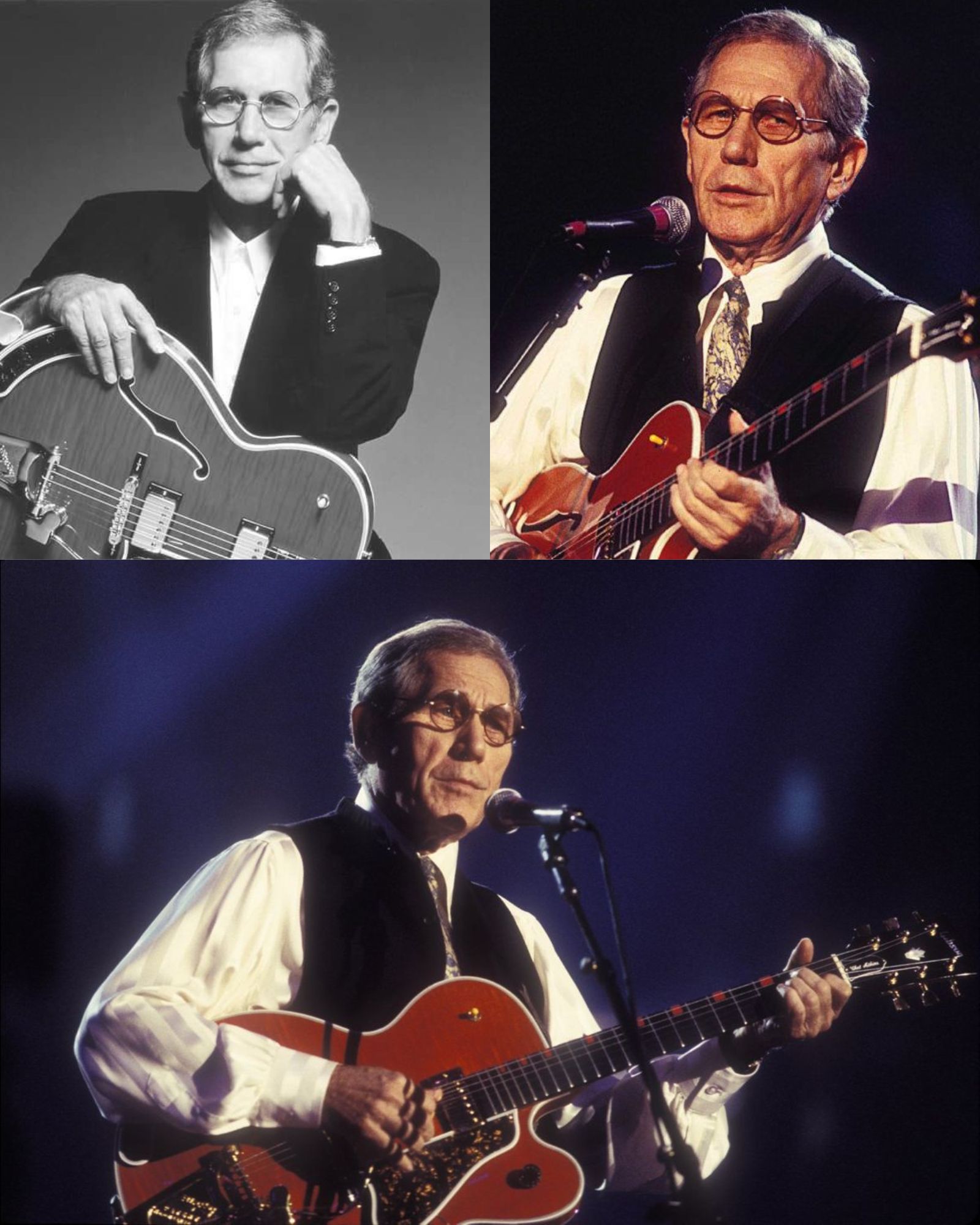
On Tuesday, July 3, 2001, something unusual stood beneath a spotlight at Nashville’s historic Ryman Auditorium. An orange Gretsch guitar rested on the stage, with a familiar white hat nearby. Both belonged to Chet Atkins.
But this time, there would be no performance from the man who had made that guitar famous.
Three days earlier, on Saturday, June 30, Chet Atkins had died at the age of 77. Now, inside the building known as the Mother Church of Country Music, Nashville had gathered to say goodbye.
The musicians who came were not simply paying tribute to a gifted guitarist. Many owed important parts of their careers to Chet Atkins, the quiet producer and musician who had helped change the sound of country music.
And before the service was over, one familiar gospel hymn would give the gathering a deeply personal beginning.
A Guitar, a White Hat, and a Familiar Hymn
The Ryman Auditorium had hosted countless memorable country music performances, but the gathering on July 3 was different.
Near the front of the stage stood Chet Atkins’ closed casket. Under the spotlight rested the orange guitar, while a stool held the signature Panama hat that had become part of the musician’s image.
Then Connie Smith began the service with “Farther Along,” a traditional gospel hymn about sorrow, patience, and the hope that life’s difficult questions will someday be answered.
Connie Smith was accompanied by musicians including Marty Stuart, Connie Smith’s husband and another longtime admirer of Chet Atkins.
For a gathering filled with people who had spent their lives making music, beginning with an old gospel hymn felt especially appropriate. The farewell was not built around a grand production. It was about musicians honoring another musician.
Eddy Arnold, whose career had been closely connected to Chet Atkins, delivered an emotional tribute and struggled to maintain composure.
Then the guitars began speaking for themselves.
Paul Yandell, Chet Atkins’ longtime musical partner, performed “Windy and Warm” and “Mr. Sandman.” Steve Wariner played “Sails,” while Vince Gill contributed “Wildwood Flower.”
These were more than familiar melodies. They represented the playing style that had made Chet Atkins one of the most influential guitarists in American music.
The Ryman Had Welcomed Chet Atkins 55 Years Earlier
One of the most remarkable moments came when radio personality Garrison Keillor delivered the eulogy.
Garrison Keillor reminded the audience that the Ryman Auditorium had played an important role in Chet Atkins’ story long before anyone called the guitarist “Mr. Guitar.”
In the summer of 1946, Chet Atkins appeared at the Grand Ole Opry as a young guitarist working with Red Foley.
During that appearance, Red Foley introduced the young musician, then known professionally as Chester Atkins, to play an instrumental called “Maggie.”
According to the story Garrison Keillor shared, Minnie Pearl approached Chet Atkins afterward, kissed the young guitarist, and warmly praised the unusual playing style.
At the time, Chet Atkins was still building a career. The fingerpicking technique that would eventually influence generations of musicians was far from universally accepted.
Yet here was Nashville, 55 years later, honoring that same guitarist on the very stage where Minnie Pearl had once offered encouragement.
The Man Who Was Once Told He Didn’t Sound Country Enough
Perhaps the greatest irony of Chet Atkins’ career was that the revolutionary guitar style had once cost the musician a job.
During the 1940s, officials at radio station KWTO in Springfield, Missouri, considered Chet Atkins’ playing too polished for traditional country music. Chet Atkins was eventually dismissed.
But the style that some radio executives had rejected would become part of the foundation of modern Nashville recording.
As an RCA producer and executive, Chet Atkins helped develop the Nashville Sound, introducing smoother arrangements and broader musical influences that brought country records to new audiences.
Chet Atkins worked with and supported artists including Jim Reeves, Eddy Arnold, Charley Pride, and Waylon Jennings. The influence extended far beyond guitar solos.
Waylon Jennings was among those who came to the Ryman to pay respects. Although Chet Atkins and Waylon Jennings had sometimes disagreed in the recording studio, their professional relationship produced important music and a lasting mutual respect.
By the end of the career, Chet Atkins had earned 14 Grammy Awards and a place in the Country Music Hall of Fame.
One Last Goodbye at the Mother Church
During the funeral, Garrison Keillor also shared memories of the private Chet Atkins: a man with a dry sense of humor, a deep curiosity about music, and genuine enthusiasm for other musicians.
There was something fitting about the contrast between the public achievement and the simple objects on the stage.
The guitar represented countless hours of practice, recording sessions, concerts, and musical discoveries. The white hat recalled the familiar figure audiences had watched for decades.
And the gospel hymn Connie Smith had sung at the beginning offered a reminder that even the most extraordinary musical lives eventually reach a final goodbye.
Chet Atkins had once been told that the guitar playing did not fit country music.
Fifty-five years after that young musician appeared at the Ryman, Nashville gathered in the same historic room to honor the man who had helped determine what country music would become.
The man who had once been considered too different for country music was now being remembered as one of its defining voices.
And on that Tuesday in July, the orange guitar remained beneath the spotlight, while other musicians played the songs Chet Atkins had left behind.