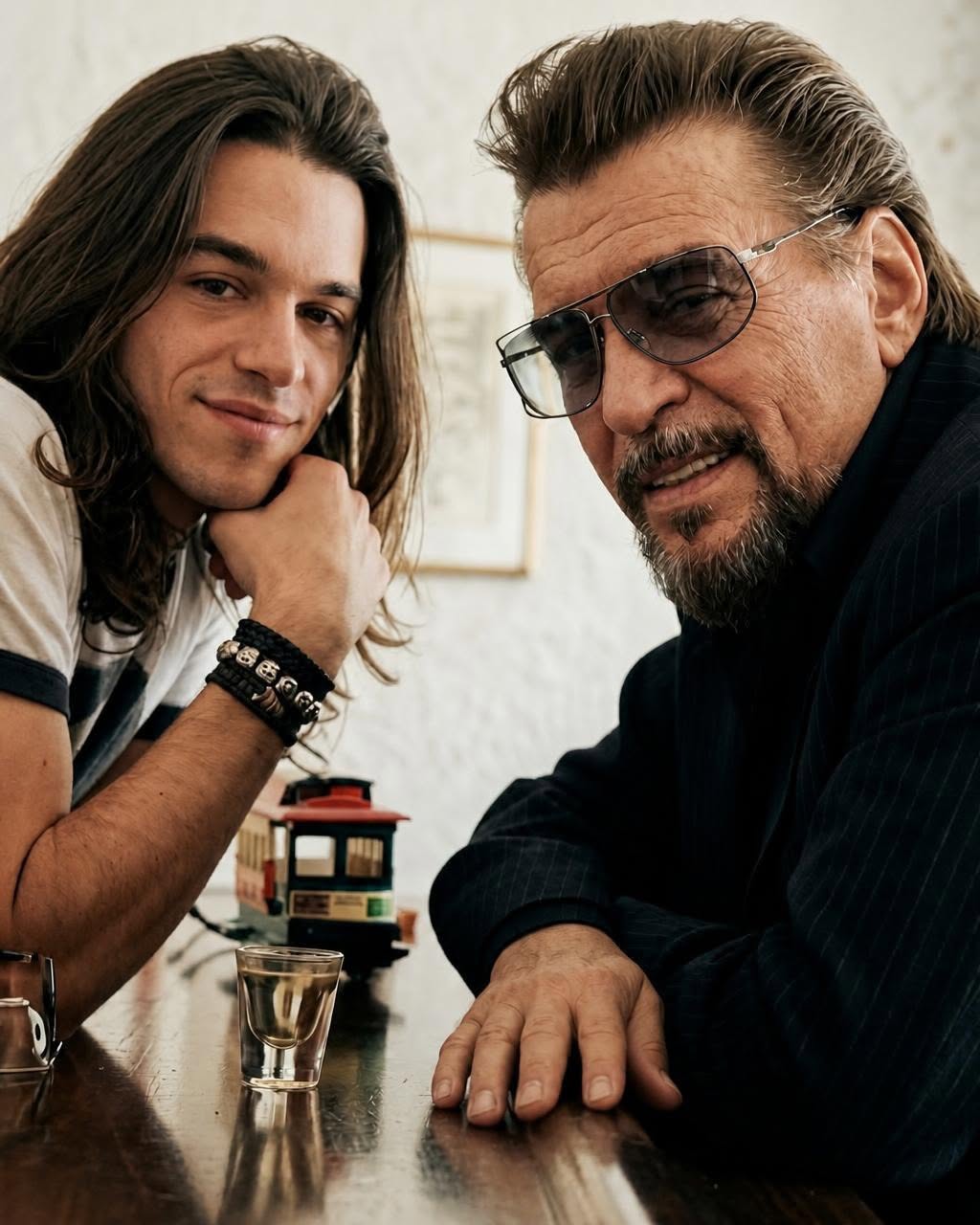
Waylon Jennings, Shooter Jennings, and the Song That Carried a Family Forward
“I’ve always been crazy, but it’s kept me from goin’ insane.” For many listeners, that line became inseparable from Waylon Jennings himself: blunt, weary, funny, and honest all at once. It sounded like defiance, but it also sounded like survival.
Waylon Jennings died on February 13, 2002, at his home in Chandler, Arizona, from complications of diabetes. He was 64. By then, he had already become a towering figure in country music, known for helping lead the outlaw movement, recording Honky Tonk Heroes, and standing beside Willie Nelson, Johnny Cash, and Kristofferson as one of The Highwaymen. He left behind a long list of hits and a legacy that had already moved from rebellion into legend.
But at the center of the story was something smaller and more personal: a son trying to understand his father through music.
Shooter Jennings was 22 when Waylon died. Two days later, at a family memorial in Arizona, Shooter stepped forward and sang “I’ve Always Been Crazy.” The choice felt both simple and devastating. It was not a performance meant to impress anyone. It was a son reaching for the one language the family had always shared: song.
Years passed, and Shooter kept listening. As he worked through Waylon Jennings’ archive, he discovered hundreds of full-band recordings that had never been released. Some of them dated back to the heart of Waylon Jennings’ most active years in the 1970s and 1980s. What Shooter found was more than leftover material. It was a hidden map of a career that still had room to surprise even the people closest to it.
The Voice That Refused to Fade
When Shooter Jennings began sorting the tapes, he described uncovering entire “hidden albums.” That phrase carries weight, because it suggests not just lost songs, but lost chapters. For fans, it meant a chance to hear a familiar voice in a new light. For Shooter Jennings, it meant hearing his father as both a public icon and a private presence.
The first of those projects, Songbird, arrived in October 2025. It was released as a newly assembled album from unreleased Waylon Jennings recordings, giving listeners another chance to hear the grit and warmth that made his voice so unmistakable. More than two decades after singing goodbye at the memorial, Shooter was now helping bring his father back into the room in a different way.
There is something moving about that kind of return. Not a miracle, not a rewrite, but a careful hand opening a box that had been sealed for years. The result is not just nostalgia. It is continuity.
Some voices leave records. Others leave a family to carry them further.
What the Music Still Says
Waylon Jennings’ story has always contained contradictions: defiant and tender, restless and disciplined, larger than life and deeply human. That is part of why his music still lands so strongly. It does not pretend that life is tidy. It admits the scars and keeps singing anyway.
Shooter Jennings’ role in that story is quietly powerful. He is not only preserving a legacy; he is listening for the parts that time nearly buried. In doing that, he has turned grief into stewardship. The result is a family story that keeps unfolding, one track at a time.
For longtime fans, Songbird is a reminder that great artists can still surprise us after they are gone. For newer listeners, it is an invitation to go back to the source. And for Shooter Jennings, it is something even more personal: a way to keep talking to Waylon Jennings through the work that never really stopped.