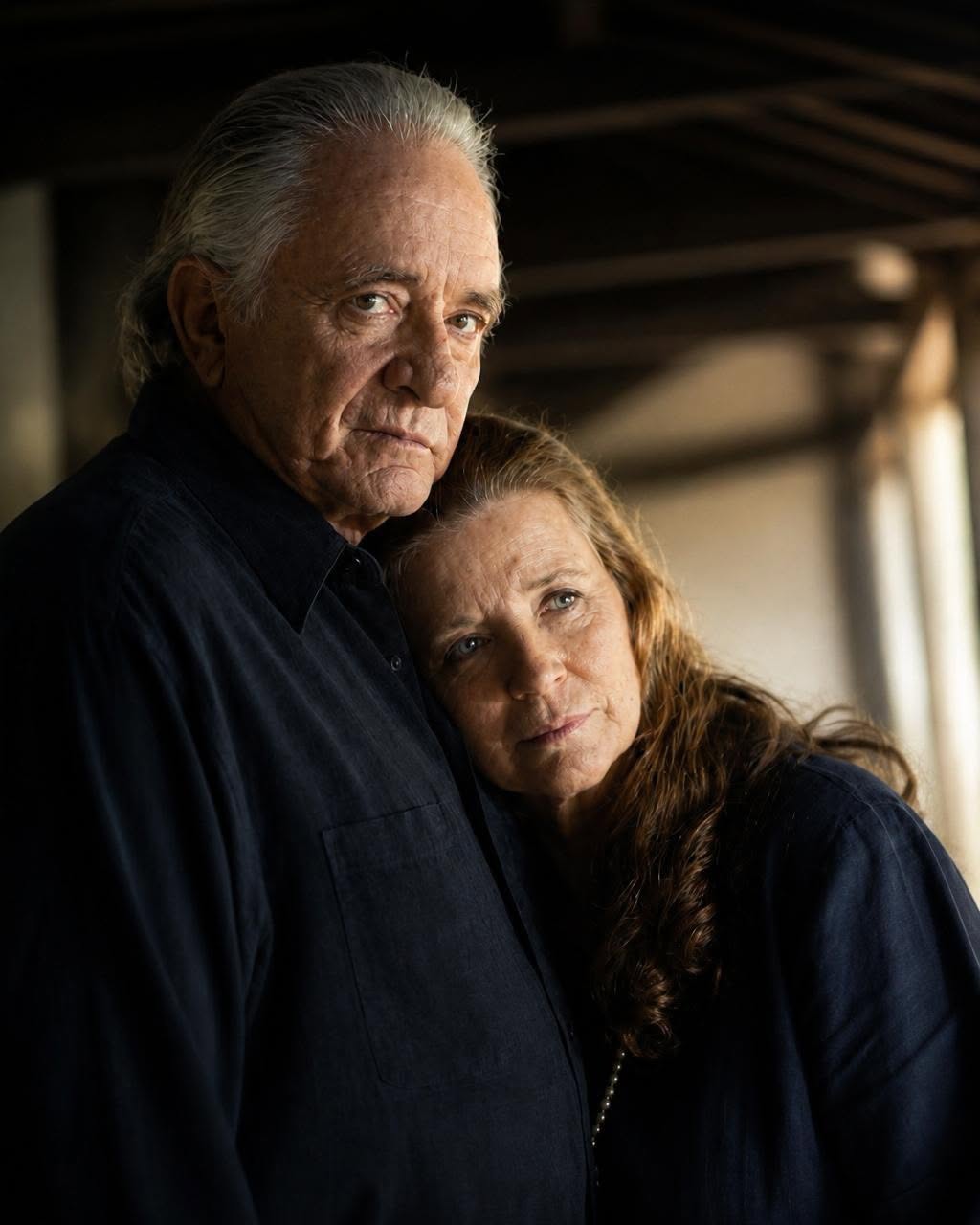
Johnny Cash’s Final Days: A Farewell That Felt Like Home
On the morning of Friday, September 12, 2003, Johnny Cash died in Nashville at the age of 71. His death came after a long period of fragile health, and the cause was reported as complications from diabetes that led to respiratory failure. For fans who had followed his music for decades, the news landed with quiet shock. For the people closest to him, it was the end of a harder chapter that had already begun months earlier.
June Carter Cash had died on May 15, 2003, and Johnny Cash lived exactly 120 more days. That number gives the loss a sharp edge, but the meaning was more emotional than mathematical. He had lost not only his wife, but also the person who had shared his stage, steadied his life, and stayed beside him through the long stretch of his career. In the months after June Carter Cash’s death, Johnny Cash’s health declined, and his world grew smaller.
A Church Full of Love and Memory
Three days after his death, about 1,500 people gathered at First Baptist Church in Hendersonville, Tennessee, for the funeral. It was the same church where Johnny Cash had said goodbye to June Carter Cash only months before, and that detail gave the service a painful symmetry. The room held family, friends, and musicians, along with many people who had known Johnny Cash only through his songs, his image, and his voice.
The music that day carried the weight of remembrance. Sheryl Crow, Emmylou Harris, and the Fisk Jubilee Singers were among those who helped fill the church with song. Kris Kristofferson, wearing a black coat, spoke to the congregation and described Johnny Cash as “the best of America.” It was the kind of line that sounded grand, but in that room it felt personal and earned.
Family, Faith, and One Last Song
Many famous names were present, but the final goodbye belonged to Johnny Cash’s family. They gathered onstage and sang a hymn for the man whose music had reached prisons, churches, and living rooms for half a century. That moment said more than any headline could. It was not a performance. It was a farewell offered in the language Johnny Cash had always understood: faith, harmony, and endurance.
Johnny Cash spent a lifetime singing about judgment, redemption, and going home.
After the service, Johnny Cash was carried to Hendersonville Memory Gardens and buried beside June Carter Cash. The Man in Black had long sounded like a man wrestling with darkness, but he also kept returning to the possibility of grace. In the end, his resting place reflected the deepest truth of his life: home was not only a place, but a person. After 120 days apart, Johnny Cash and June Carter Cash were together again.
For the people who loved him, that burial brought a hard kind of peace. Johnny Cash’s story did not end in silence; it ended in music, family, and memory. And that is why the farewell still feels so human today.