When the Grand Ole Opry Said Goodbye to Loretta Lynn
The night at the Grand Ole Opry House was not only a concert. It felt like a shared memory, a final thank-you from country music to one of its boldest voices. Loretta Lynn had died on October 4, 2022, at her home in Hurricane Mills, Tennessee, at the age of 90, and just weeks later family, friends, and fans gathered to honor her life and songs.
Loretta Lynn’s story had always carried the weight of the real world. She came from a poor coal-mining family in Kentucky, married young, raised children early, and learned to turn hardship into music. Over time, she became the woman who gave country radio songs about marriage, poverty, cheating, birth control, anger, and survival, all sung with plain honesty and fearless confidence.
A night built on memory
At the celebration, the performances seemed to trace her life from the beginning. George Strait sang “Don’t Come Home A-Drinkin’,” one of Loretta Lynn’s signature songs. Tanya Tucker performed “Blue Kentucky Girl.” Keith Urban played a voicemail Loretta Lynn had once left him before singing “You’re Lookin’ at Country.” Each moment felt like a different chapter from the same long story.
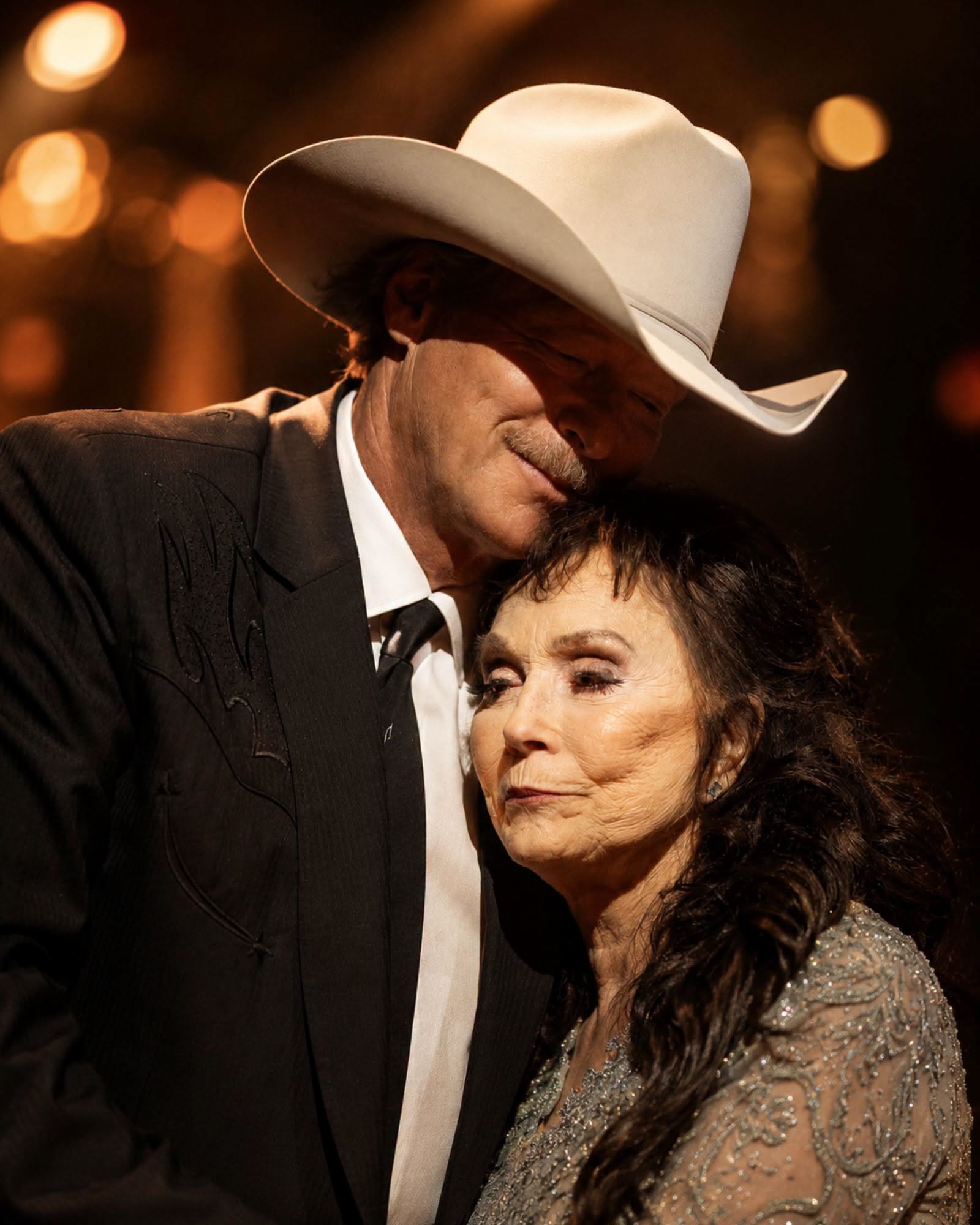
Then Alan Jackson stepped onto the stage. He did not reach for one of Loretta Lynn’s best-known hits. Instead, he chose something quieter and deeply personal: “Where Her Heart Has Always Been,” the song he wrote for his own mother’s funeral. Alan Jackson has described it as a song written for that goodbye, and the performance carried that tenderness into the room.
Why the song fit so perfectly
Before singing, Alan Jackson explained that Loretta Lynn reminded him of his mother. He said both women were sweet, genuine, outgoing, and never afraid to tell people exactly what they thought. That simple comparison seemed to land harder than any long speech could have. It wasn’t just about fame or legacy. It was about the kind of woman who stays real in every room she enters.
In that moment, Loretta Lynn was not only a country legend. She was someone’s motherly presence, someone’s reminder of home.
That is what made the tribute so moving. Loretta Lynn had spent her career telling the truth about women’s lives, and the final song from Alan Jackson honored that truth in a different way. It was gentle instead of flashy, intimate instead of grand. The choice suggested that the deepest tribute is sometimes the most personal one.
A farewell that felt like love
Fans who watched that evening saw more than a memorial. They saw country music speaking back to one of its own with gratitude and affection. Loretta Lynn had spent decades making room for hard truths in a genre that did not always welcome them. On that night, the Grand Ole Opry House gave her a farewell worthy of that courage.
For America, Loretta Lynn will always be the Coal Miner’s Daughter. But in the soft light of that tribute, Alan Jackson helped people remember something else too: before the legend, before the headlines, before the history books, she was a woman who made others feel at home. And that may be the most lasting kind of goodbye.