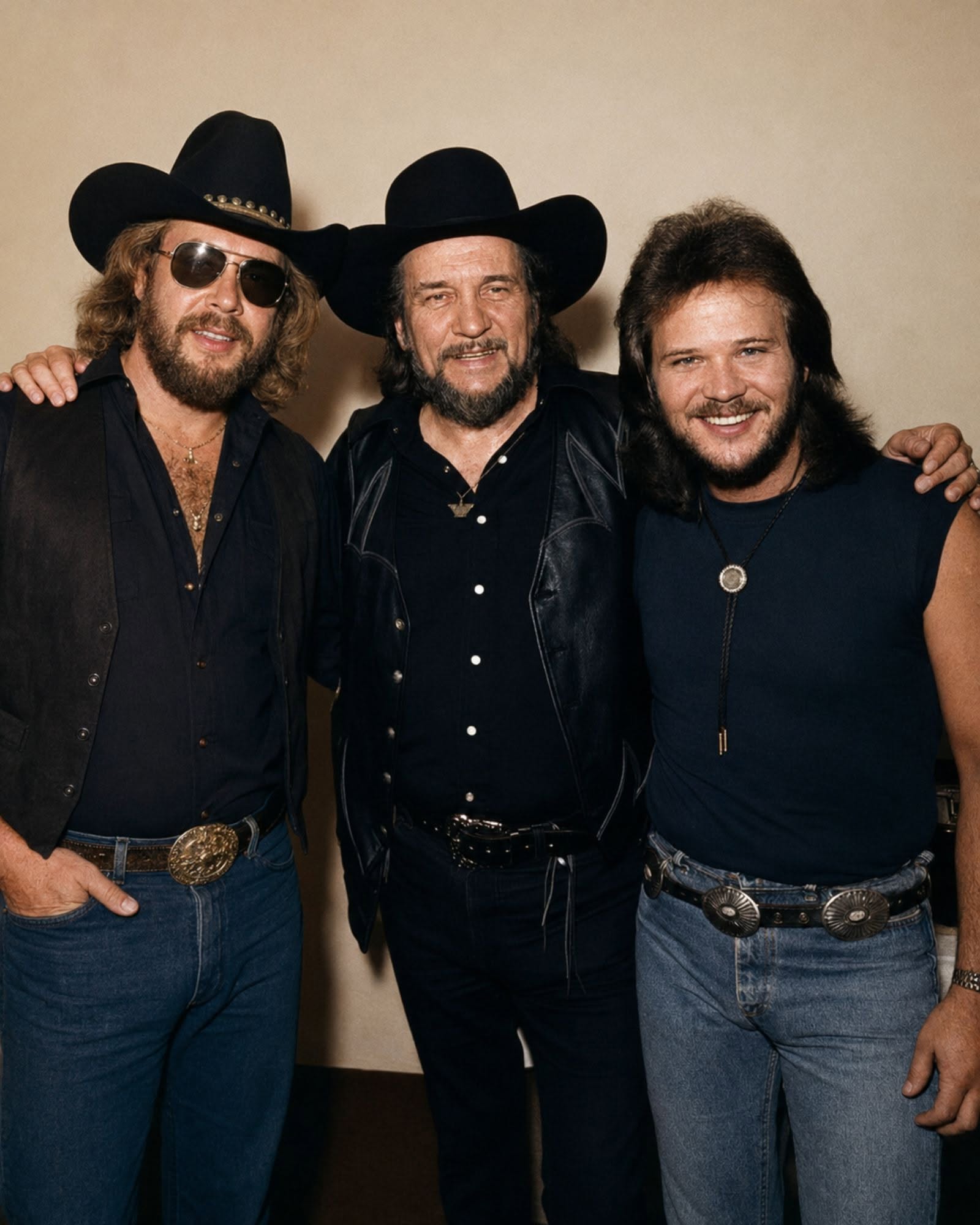
When Waylon Jennings Was Gone, Hank Williams Jr. Came Back to the Opry
Waylon Jennings carried a hard story for most of his life. In 1959, he gave up his seat on a small plane to a friend, and that plane later crashed in Iowa, killing Buddy Holly, Ritchie Valens, and the Big Bopper. The joke he made before takeoff haunted him for decades, and he never seemed to escape the weight of that moment. He became one of country music’s most uncompromising voices, but the guilt never fully left him.
On February 13, 2002, Waylon Jennings died at home in Chandler, Arizona, at age 64. For friends, fans, and fellow musicians, the loss felt bigger than one man. It closed a chapter in country music that had always seemed rowdy, fearless, and deeply human all at once.
Then, just three days later, something unusual happened at the Ryman Auditorium in Nashville. The room was filled with the kind of quiet that only comes when a place understands it is holding history. Hank Williams Jr. returned to the Grand Ole Opry stage after more than two decades away, and he did it for Waylon.
Hank Williams Jr. had not stepped on that stage since 1980. That alone made the moment remarkable. But the reason mattered even more. This was not a publicity appearance or a planned revival. It was a farewell, shaped by friendship and grief. Travis Tritt and Marty Stuart stood with Hank Williams Jr., and together they performed for more than an hour.
A Stage with a Memory
The Ryman Auditorium has always carried its own memory. It is the Opry’s most famous former home, a place where country music legends left fingerprints on the air long before modern Nashville built bigger lights and louder systems. On this night, one stool was left empty onstage, a simple gesture that said more than words could.
Hank Williams Jr. sang “Eyes of Waylon,” a song he had written years earlier after a chance airplane meeting with Waylon Jennings. The song had become a quiet tribute long before Waylon Jennings died, and on this night it sounded like a promise kept. The performance turned sorrow into something communal, something shared by the musicians onstage and the audience listening in silence.
More Than a Comeback
What made the evening powerful was not just that Hank Williams Jr. returned. It was that he returned for someone who had never stopped mattering to him. Country music often tells stories about broken rules and rebel spirits, but this one was about loyalty. It was about a man who had sworn off a sacred stage, then walked back onto it because friendship asked him to.
By the end of the night, the room held both ache and grace. Waylon Jennings had spent years wrestling with guilt, and Hank Williams Jr. had spent years away from the Opry. For one evening, those separate histories met in the same building. The result was not polished or neat. It was better than that. It was honest.
The man who broke every rule Nashville ever wrote got his goodbye on Nashville’s most sacred stage.
That is why the memory lasts. Not because it was perfect, but because it felt true. In country music, the biggest moments often arrive dressed as simple ones. A song. An empty stool. A friend coming back when it matters most.