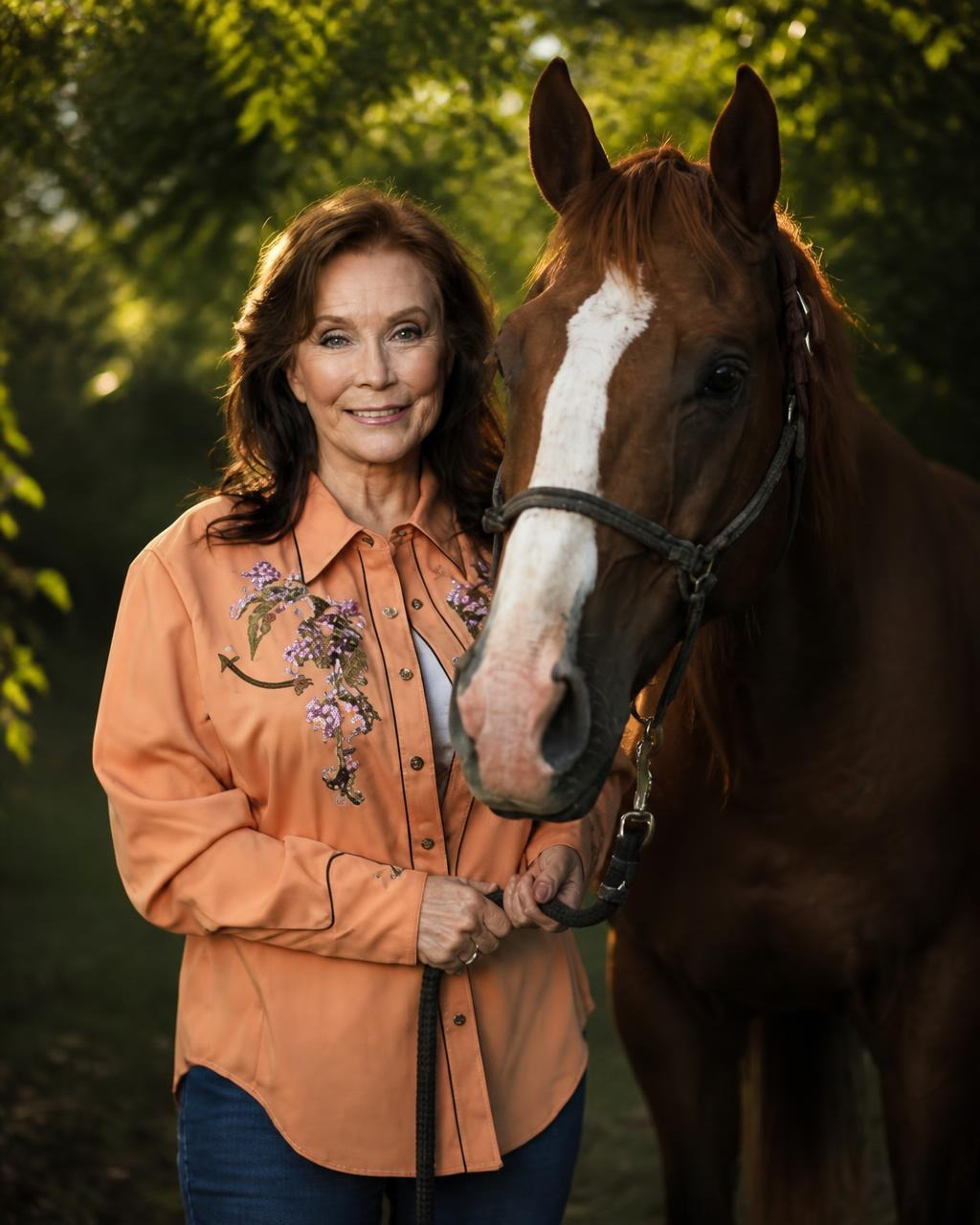
From a Woman Who Owned Horses in Tennessee to a Legend Honored at the Kennedy Center
Loretta Lynn never needed a grand stage to prove who she was. In Hurricane Mills, Tennessee, she built a life that stayed close to the ground: open fields, steady work, and horses that matched her pace better than any spotlight ever could. At Loretta Lynn’s Ranch, the setting reflected the woman herself. It was practical, rooted, and deeply tied to the world she came from.
That ranch became more than property. It became a home base, a place where Loretta Lynn could return after the noise of fame and find something familiar again. The quiet of the land, the horses, and the simple rhythm of rural life stood in contrast to the public image of a country star. Yet both versions of Loretta Lynn were always true. She could sing to the world and still belong to the fields.
Then came the night the country music icon stepped into a very different kind of room. In Washington, D.C., the Kennedy Center Honors placed Loretta Lynn among artists celebrated for lifetime contributions to American culture. The 2003 honorees included Loretta Lynn, James Brown, Carol Burnett, Mike Nichols, and Itzhak Perlman, a group that reflected the breadth of American performance and influence.
The difference between the ranch and the Kennedy Center could not have been sharper. One was shaped by horses, dust, and open sky. The other by chandeliers, formalwear, and applause that echoed through a national theater. But Loretta Lynn did not have to become someone else to fit the moment. She carried the same voice that had made her a star in the first place: direct, honest, and unafraid to tell the truth.
From the fields of Tennessee to one of the nation’s highest cultural honors, Loretta Lynn’s journey was never about leaving her world behind. It was about bringing that world with her.
That is why her story still resonates. Loretta Lynn stood for survival, womanhood, and the stubborn dignity of saying things plainly. Her songs came from a life that was lived, not invented. The horses in Hurricane Mills carried her body through the land she loved. The songs carried her voice much farther, into homes across the country and into the history books, where she remains a lasting symbol of country music’s truth and reach.