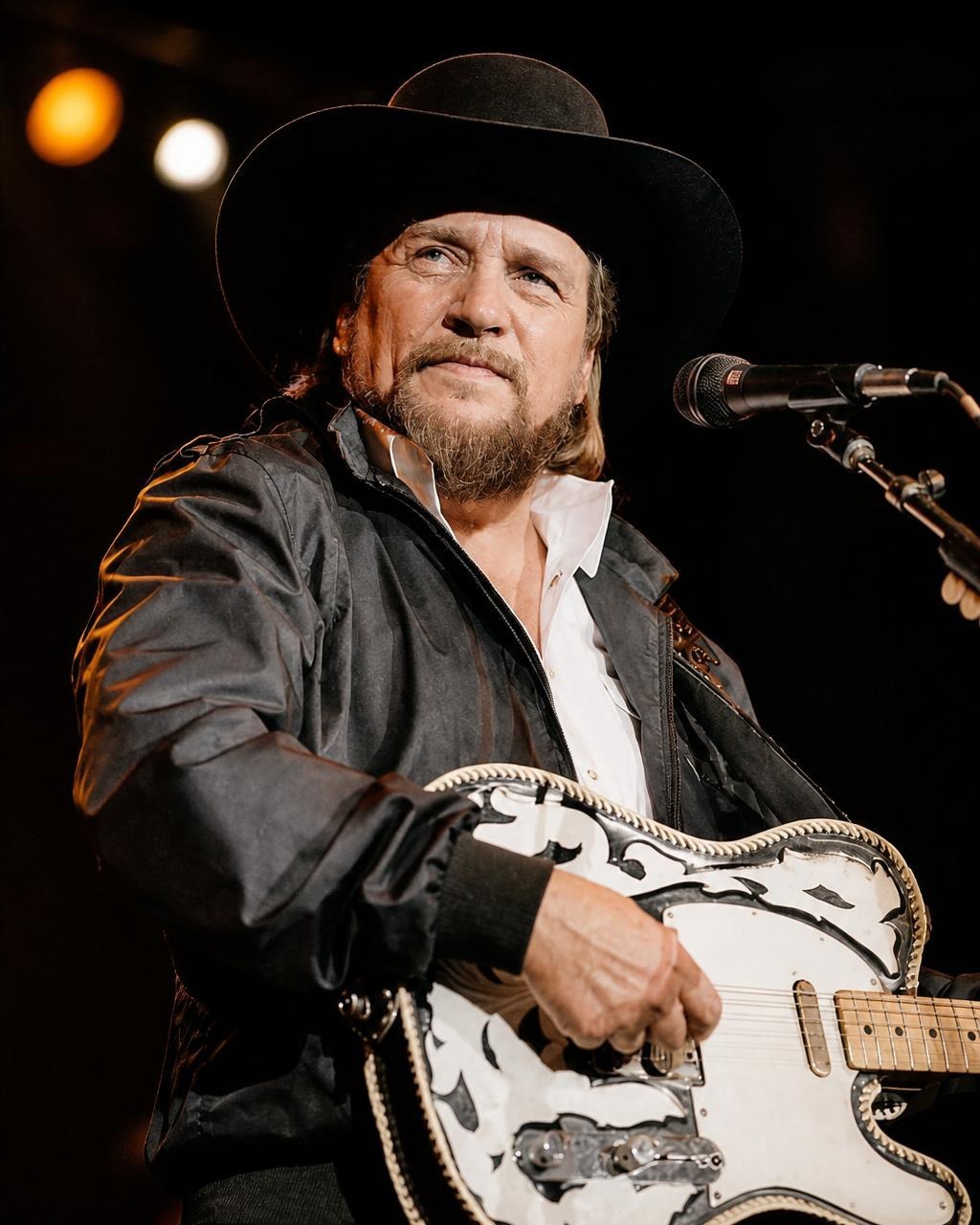
Waylon Jennings Received Two Goodbyes, and Neither Needed a Crowd
They buried Waylon Jennings in a private graveside service in Mesa, Arizona, with no cameras and no public spectacle. The family did not name who attended, and that silence felt fitting for a man who spent much of his life resisting rules, polished endings, and anything that looked too official. His final wish was simple: a quiet funeral without fanfare.
But Nashville could not let the story end there.
On March 23, 2002, five weeks after his burial, the Ryman Auditorium opened its doors for a memorial service that felt both restrained and deeply personal. The old stage was dressed in a black backdrop with the silver “W” from his road show. Waylon Jennings’ black guitar stood upright, his black cowboy hat resting on top, with red rose petals scattered at the base. It was a tribute that understood him better than any formal speech could.
Travis Tritt spoke about Waylon Jennings’ refusal to do anything halfway. He was a man who stood with one foot in traditional country and the other in rock and roll, and he never apologized for the mix. Kris Kristofferson put it even more plainly, calling Waylon Jennings “an American archetype,” a bad guy with a big heart. That balance — rough edges, deep feeling — defined the way many people remembered him.
Shooter Jennings, his son, gave the room a sharper kind of truth. He told the audience, “Basically, he taught us all how to rock. And tonight we’re going to show him what we’ve learned.” It was the kind of sentence that landed because it sounded earned, not rehearsed.
Messages also came from Paul Simon, Graham Nash, and Neil Diamond. The service carried the weight of a full life: not just the hits, but the friendships, the influence, and the stubborn originality that made Waylon Jennings impossible to box in. When the two-hour tribute ended, the final song was The Dream, the last song Waylon Jennings wrote and recorded. His voice filled the Ryman one more time, carrying the line, “all I can say is I’ve had it both ways, and the dream could never compare.”
The crowd answered with shouts of “God bless you.”
Waylon Jennings spent his life refusing Nashville’s ceremonies. In the end, Nashville held one anyway — and, somehow, it did.