The Day the Grand Ole Opry Brought George Jones Home
On a Thursday morning in Nashville, the Grand Ole Opry House felt less like a performance venue and more like a sacred room of memory. George Jones had died on Friday, April 26, 2013, at age 81, and by the time mourners gathered six days later, the grief in the building had already settled in like a quiet storm. Fans lined up before sunrise to say goodbye to the man countless country listeners knew as The Possum.
At the front entrance, a wreath hung in a way that echoed the feeling of one of George Jones’s most famous songs. Inside, the service became a final reunion of Nashville’s most familiar voices. Former First Lady Laura Bush attended, and so did governors, friends, and artists who had carried George Jones’s music for decades. The memorial stretched nearly three hours, and every part of it seemed to remind the crowd that George Jones was not just a singer, but a standard-bearer for country music itself.
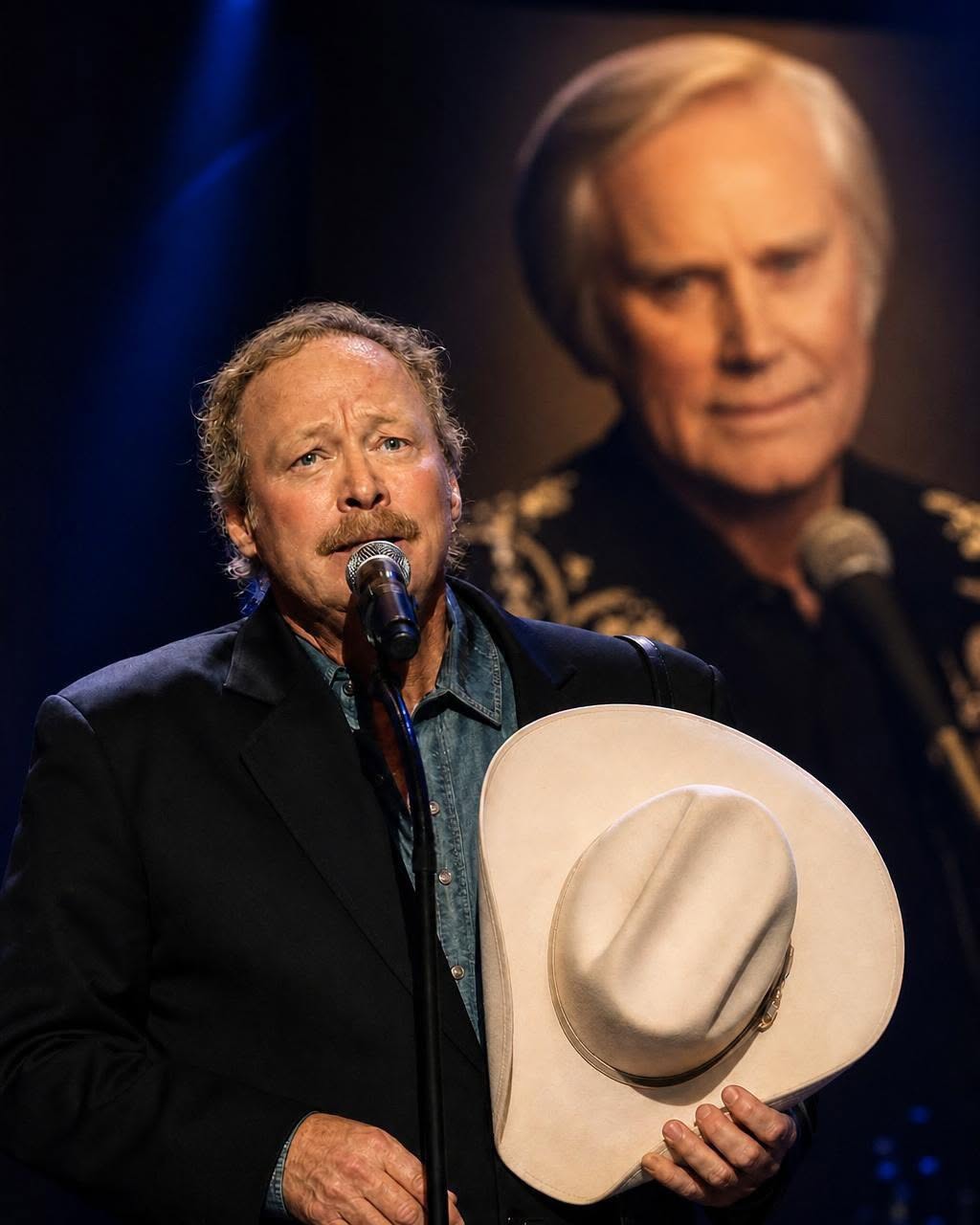
Then came one of the day’s most unforgettable moments. Alan Jackson stepped onto the Grand Ole Opry stage and sang “He Stopped Loving Her Today.” The song had long been tied to George Jones’s legacy, and the performance felt like a farewell spoken in the language George Jones understood best. At one point, Alan Jackson removed his white cowboy hat in a gesture that made the room seem even stiller. It was a simple act, but it carried the weight of respect, memory, and love.
Other tributes cut just as deeply. Vince Gill and Patty Loveless performed together, and the emotion in the room was so strong that the lead seemed to pass between them like a shared burden. Voices shook. The audience listened in silence. No one in that building needed to be told what George Jones had meant to country music; they could hear it in every cracked note and every pause between lines.
When the service ended, George Jones’s own recording of “When the Last Curtain Falls” played as pallbearers carried his casket off the Opry stage for the final time. Later, he was buried at Woodlawn Cemetery in Nashville, not far from the place where his voice had lived for 57 years. The distance was small, but the meaning was enormous. George Jones had come full circle, leaving behind a stage, a city, and a songbook that still feels alive whenever country music turns toward honesty, heartbreak, and truth.