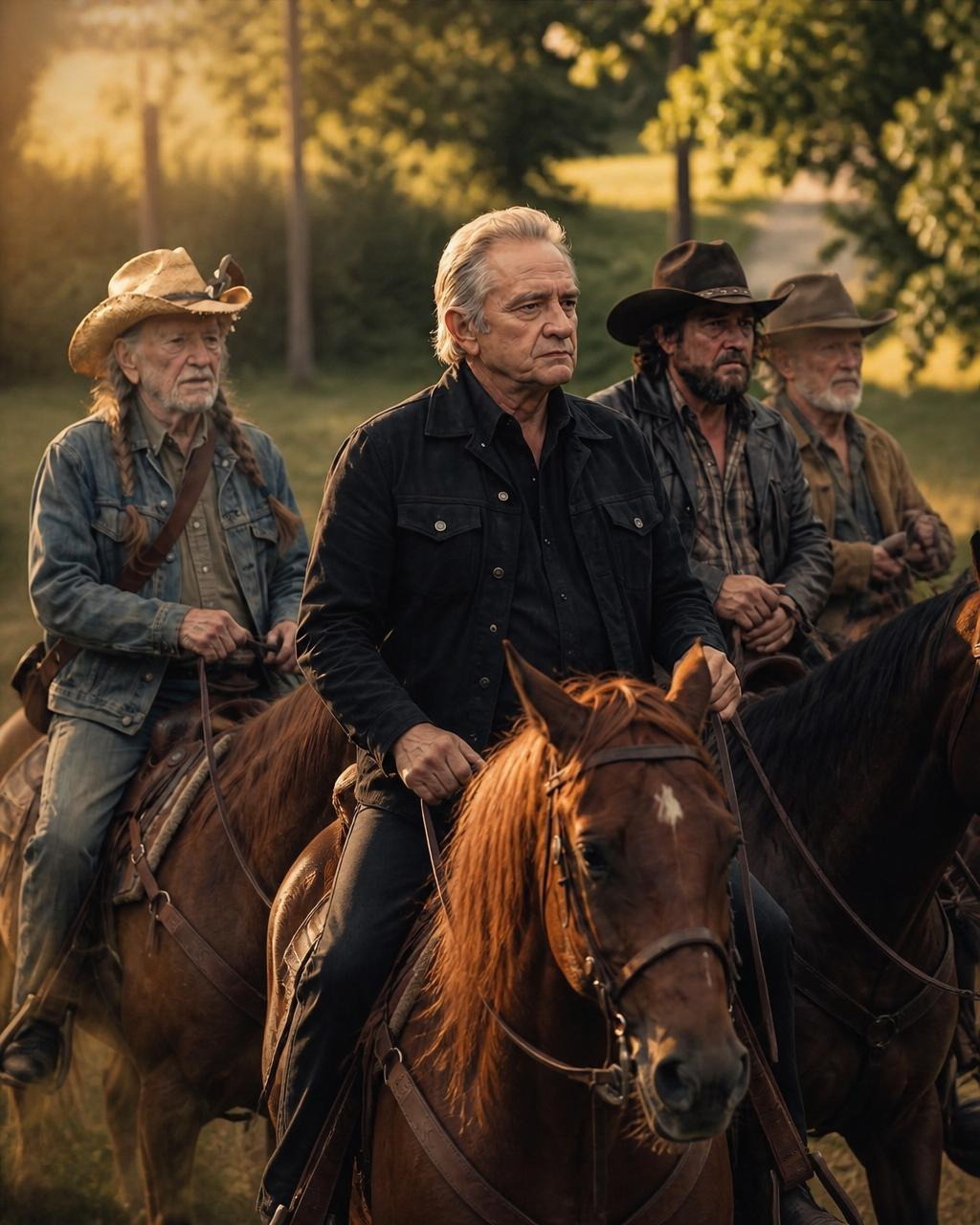
FOUR VERSES. FOUR OUTLAWS. NO HARMONY REQUIRED — THE STORY BEHIND “HIGHWAYMAN”
Some songs arrive like lightning. Others come together in a hotel room, after the work is done and the cameras are off. That is how “Highwayman” entered country music history: not as a carefully planned anthem, but as a song that found the right four voices at the right moment.
The story begins in the mid-1980s, when Johnny Cash, Willie Nelson, Waylon Jennings, and Kris Kristofferson were already legends in their own right. They had the kind of presence that made a room feel smaller. In 1984, while working on a Christmas special in Switzerland, they ended up jamming late in a hotel room. The moment was loose, informal, and full of friendship. But there was a problem: when they tried to sing together, the blend was not easy. Four huge voices did not instantly become one. They needed a song that respected who they were.
That answer came through Marty Stuart, who suggested Jimmy Webb’s “Highwayman.” The song was built differently. It had four verses, and each verse could belong to one singer. No forced harmony. No competition. Just four distinct lives moving through the same melody. Johnny Cash reportedly loved the idea and asked for the verse about the starship, the one that carried the song beyond the dusty road and into the future.
The result was more than a novelty. It became a statement. “Highwayman” connected the four artists with a kind of mythic ease, as if the song had been waiting for them all along. It rose to No. 1 on the country chart in 1985, and it remained the only No. 1 they ever had together as a group.
A song built on friendship
Rosanne Cash later described the project as something born out of pure friendship, not a marketing plan. That matters, because the song still feels that way. It does not sound assembled. It sounds lived in. The voices of Johnny Cash, Willie Nelson, Waylon Jennings, and Kris Kristofferson carry separate histories, yet the song lets each one stand alone for a moment before passing the story forward.
There is also something tender in the way the group’s story ended. In 1993, they played what became their last show together in Ames, Iowa. No dramatic farewell. No grand announcement. They simply walked off the stage. That quiet ending fits a group that never needed to explain itself too much. They were already larger than the moment.
The verse that stays behind
Part of the song’s power is that listeners can attach themselves to a different verse each time. Some people hear the outlaw on the open road. Some hear the sailor, or the dam builder, or the starship captain. The song invites reflection without demanding a single interpretation.
Which verse hits hardest depends on the listener, and that is part of the magic.
Over the years, the Highwaymen became more than a supergroup. They became a memory of what country music could sound like when ego stepped aside and storytelling took over. Today, only Willie Nelson remains, the last Highwayman standing. That fact gives the song a deeper ache, but it also preserves its warmth. “Highwayman” was never just about travel, or death, or reinvention. It was about four friends meeting a song that could hold them all.