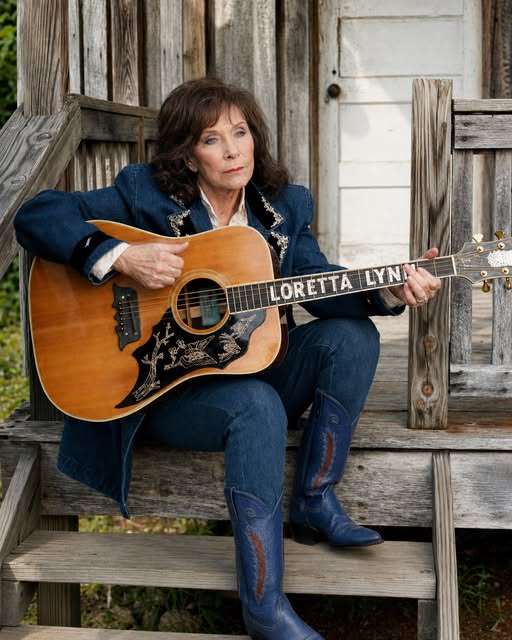
Loretta Lynn and the Quiet of Hurricane Mills
In her final years, Loretta Lynn found a kind of peace that did not need applause. After a life spent crossing stages, crossing state lines, and crossing the rough ground between hardship and stardom, she spent much of her later life at her ranch in Hurricane Mills, Tennessee. It was a place where the world slowed down. There was room there for a rocking chair, for the wind, for memory, and for the long view of a woman who had lived enough for several lifetimes.
Loretta Lynn was born in Butcher Hollow, Kentucky, in 1932, and her early life shaped everything that came after it. She married young, became a mother young, and built her career by turning private struggle into songs that felt public and true. Her music gave voice to women who were often expected to stay silent. She sang about marriage, family, double standards, and the everyday pressure of making a life hold together. People did not just hear Loretta Lynn; they recognized her.
By the time she reached her later years, the fighting spirit that once pushed her forward had softened into something quieter. She had already outlived her husband, Doolittle Lynn, and several of her children. She had also outlasted many of the friends and fellow performers who had been part of her rise. Yet even then, she remained rooted in the same plain truth that had always made her powerful: she was still Loretta Lynn, still watching the hills, still listening to the land around her.
A life measured in songs and survival
What made Loretta Lynn unforgettable was not only her voice, but her refusal to pretend life was neater than it was. She wrote and recorded songs that reached into subjects many others avoided, and she did it with confidence that felt direct and fearless. That honesty followed her through fame and into old age. Even when her memory began to fade, family members said that certain songs still brought something back. A familiar melody could change the air in the room. “Coal Miner’s Daughter” could still open a door to the past.
That detail feels important. It suggests that for Loretta Lynn, memory was not only about facts and dates. It was also about feeling. A voice, a tune, a few familiar lines could carry her back to Kentucky, back to childhood, back to the life before the bright lights and long tours. In that way, the porch in Hurricane Mills was not an ending so much as a return.
Some legends spend their final chapter still reaching for the stage. Loretta Lynn seemed to reach for the quiet.
The last kind of strength
There is something moving about the image of Loretta Lynn sitting outside, watching the Tennessee hills, with nothing to prove. It is easy to remember the hit records, the awards, and the fearless songs. It is harder, and perhaps more meaningful, to imagine the woman behind all of it simply resting in the afternoon light. Not performing. Not explaining. Just being present.
That may be why Loretta Lynn’s final years continue to resonate. They feel honest. They remind us that a life built on struggle does not always end in spectacle. Sometimes it ends in stillness. Sometimes the bravest thing a person can do is accept the quiet after decades of noise.
Loretta Lynn once sang from the center of country music’s most famous stories. In the end, she returned to a smaller story: a porch, a chair, a breeze, and the hills she never stopped missing. For a woman who spent her life telling the truth in songs, that quiet ending felt like one more truth she had earned.